Why Can't I Calm My Racing Mind? (The Breathwork Techniques)
Why caffeine stops working + the cellular energy protocol combining mitochondrial support, Natural Energy Solution herbs & lifestyle rhythm. For women who've tried everything."
1/27/202614 min read
Why Can't I Calm My Racing Mind? (The Breathwork Method)
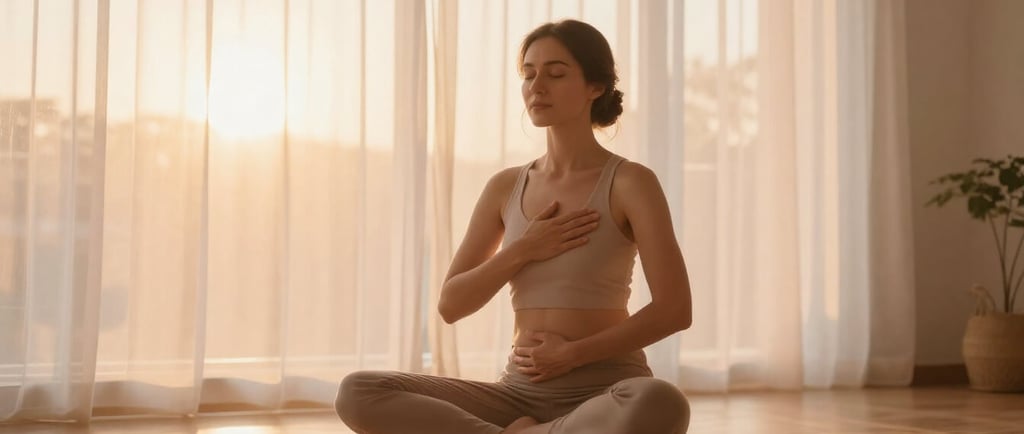
You can calm a racing mind through breathwork because your breath is the only part of your autonomic nervous system you can consciously control, giving you direct access to the switch between stress and calm. Specific patterns like extended exhale breathing, box breathing, and coherent breathing at 5 to 6 breaths per minute measurably lower cortisol, slow your heart rate, and shift your brain from anxious activation into the clear, focused state where your natural peace lives.
You're lying in bed at 2 a.m., exhausted but wide awake. Your mind won't stop. Tomorrow's presentation loops on repeat. Last week's conversation replays with all the things you should have said. Your to-do list expands like an accordion, each task spawning three more. You try to relax, to "just breathe," but your breath feels shallow, trapped high in your chest like a bird beating against a cage.
This isn't insomnia. This isn't anxiety disorder. This is your nervous system stuck in a state it was never meant to sustain, perpetual activation, chronic vigilance, the low-grade panic of modern life that feels so normal you've forgotten what calm actually feels like.
Your racing mind isn't a character flaw or a thinking problem. It's a breathing problem. And the solution has been hiding in plain sight for 5,000 years, validated by cutting-edge neuroscience only in the last decade.
Between the ancient yogis who mapped the subtle body through pranayama and the Navy SEALs who use tactical breathing to stay calm under fire lives a truth your ancestors knew intimately: Your breath is the bridge between your conscious mind and your autonomic nervous system, the only part of your automatic survival machinery you can control directly.
When you change how you breathe, you change your brain chemistry, your stress hormones, your heart rate, your blood pressure, and most importantly, the state of your mind. This isn't metaphor. This isn't wishful thinking. This is measurable, repeatable, documented physiology.
The Science Behind Your Racing Mind
Your sympathetic nervous system, the "fight or flight" response, evolved to save your life during genuine emergencies. A predator appears. Your amygdala (the brain's alarm system) fires. Within milliseconds, your hypothalamus triggers a cascade: adrenaline floods your bloodstream, your heart rate spikes, your breath quickens and shallows, blood flow redirects from your digestive system to your muscles, and your pupils dilate to take in more visual information.
This response is brilliant and life-saving when you're facing actual danger. The problem is, your primitive brain can't distinguish between a charging tiger and a difficult email. Both trigger the same physiological alarm. And in our modern world of constant notifications, financial pressure, relationship stress, work deadlines, and information overload, that alarm never fully turns off.
Your breath becomes the symptom and the cause of chronic stress. When you're stressed, your breathing shifts automatically, faster, shallower, chest-based rather than diaphragmatic. This makes perfect evolutionary sense when you're running from danger; shallow chest breathing allows for quick oxygen exchange during physical exertion.
But here's where it becomes a vicious cycle: shallow breathing itself signals danger to your nervous system. Your brain interprets rapid, chest-based breathing as confirmation that you're in threat mode, which triggers more stress hormones, which causes more shallow breathing, which signals more danger. You're trapped in a feedback loop where your breath and your anxiety are feeding each other.
Research published in Frontiers in Psychology demonstrates that breathing pattern directly influences emotional state. When participants were instructed to breathe in patterns associated with different emotions, slow and deep for calm, fast and shallow for anxiety, their brain activity and self-reported emotions shifted to match the breathing pattern, even when they weren't actually experiencing those emotions beforehand.
Your breath isn't just responding to your mental state. Your breath is creating your mental state.
Dr. Andrew Huberman, neuroscientist at Stanford, explains this through the mechanics of your brainstem. A cluster of neurons called the pre-Bötzinger complex monitors your breathing rate and pattern. When breathing is fast and erratic, these neurons send signals throughout your brain and body that you're in a state of alertness or stress. When breathing is slow, deep, and rhythmic, different signals broadcast: safety, calm, restoration.
You cannot think your way out of a dysregulated nervous system. But you can breathe your way out.
What Ancient Yogis Knew (That Neuroscience Just Proved)
Four thousand years before fMRI machines and heart rate variability monitors, yogis in the Indus Valley were conducting sophisticated experiments on consciousness using the laboratory of their own bodies. They discovered that by controlling prana, the Sanskrit word for both "breath" and "life force", they could influence mind states, emotional patterns, and even perception itself.
The Yoga Sutras of Patanjali, written around 400 CE, include pranayama (breath control) as the fourth of eight limbs of yoga. But pranayama wasn't about fitness or relaxation. It was considered a direct method for regulating the nervous system and preparing the mind for meditation, for the kind of mental stillness that makes higher states of consciousness accessible.
Specific techniques were developed for specific purposes:
Nadi Shodhana (Alternate Nostril Breathing) was used to balance the left and right hemispheres of the brain, creating mental equilibrium. Modern studies using EEG now show that this practice does indeed create greater coherence between brain hemispheres and reduces activity in the amygdala, your fear center.
Bhramari (Bee Breath) involved making a humming sound during exhalation. Yogis recognized this calmed the mind almost immediately. We now know why: humming stimulates the vagus nerve, the primary nerve of your parasympathetic "rest and digest" system, and increases nitric oxide production, which dilates blood vessels and lowers blood pressure. PudMed
Ujjayi (Victorious Breath) used a slight constriction at the back of the throat to create audible breathing. This conscious control of breath gave practitioners something to anchor attention to, preventing mind-wandering. Neuroscience now confirms that focused attention on breath activates the prefrontal cortex (your executive control center) while deactivating the default mode network (the brain's worry and rumination circuit).
The yogis weren't guessing. They were mapping cause and effect through direct observation over millennia. What they called "prana" moving through "nadis" (energy channels), we now call oxygen, carbon dioxide, and neural signaling through the vagus nerve and autonomic pathways.
Same phenomenon. Different language. Both true.
The Three Breathing Patterns That Calm Your Nervous System
Modern breathwork synthesizes ancient wisdom with contemporary neuroscience research. These three evidence-backed techniques address different aspects of nervous system dysregulation. Each works through distinct mechanisms, giving you precise tools for specific states.
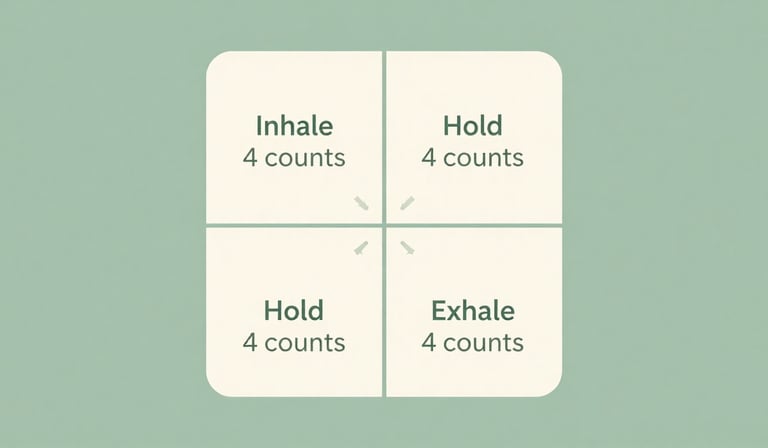
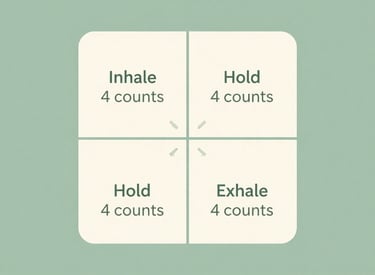
1. Box Breathing (4-4-4-4): The Tactical Reset
The Pattern:
Inhale through your nose for 4 counts
Hold your breath for 4 counts
Exhale through your nose for 4 counts
Hold empty for 4 counts
Repeat for 2-5 minutes
What It Does: Box breathing, also called square breathing or tactical breathing, is used by Navy SEALs, first responders, and performance athletes to maintain composure under extreme pressure. The equal ratio of inhale, hold, exhale, hold creates profound nervous system balance.
Holding your breath after the inhale increases carbon dioxide in your bloodstream. This isn't dangerous, it's therapeutic. CO2 tolerance is one of the most underappreciated factors in anxiety management. When you're chronically stressed, you tend to overbreathe (hyperventilate slightly), which reduces CO2 and triggers feelings of air hunger and panic. Box breathing recalibrates your CO2 sensitivity, helping your body remember that you're safe even when breath is paused.
Research published in the International Journal of Psychophysiology found that box breathing significantly reduced cortisol levels and increased parasympathetic activity within just five minutes of practice. PudMed
When to Use It:
Before stressful events (presentations, difficult conversations, medical procedures)
During acute anxiety or panic onset
When you notice your thoughts spiraling
As a morning practice to set a calm baseline for the day
2. Physiological Sigh (Inhale-Inhale-Long Exhale): The Quick Release
The Pattern:
Inhale deeply through your nose until your lungs feel full
Take a second, shorter inhale through your nose to top off the lungs completely
Exhale slowly and completely through your mouth
Repeat 1-3 times
What It Does: This pattern was identified by researchers at Stanford as the fastest way to reduce physiological stress in real-time. The double inhale fully expands the tiny air sacs (alveoli) in your lungs, some of which collapse slightly during shallow breathing. Re-inflating them allows for maximum gas exchange.
The long, slow exhale activates your vagus nerve more powerfully than any other breathing pattern. Your vagus nerve runs from your brainstem through your chest and abdomen, and it's the primary communication highway between your brain and your heart, lungs, and digestive system. When you exhale slowly, you stimulate the vagus nerve's parasympathetic fibers, which send "all clear" signals throughout your body.
Dr. Huberman's lab demonstrated that just one to three physiological sighs can shift someone from high stress to calm within 60-90 seconds, faster than meditation, progressive relaxation, or any other intervention they tested.
When to Use It:
During moments of acute stress or overwhelm
When you feel tears coming or emotions rising
After a startling event or bad news
Anytime you need an immediate reset (traffic, argument, work crisis)
3. 4-7-8 Breathing: The Sleep Inducer
The Pattern:
Inhale quietly through your nose for 4 counts
Hold your breath for 7 counts
Exhale completely through your mouth (making a whoosh sound) for 8 counts
Repeat the cycle 4 times
What It Does: Developed by Dr. Andrew Weil based on pranayama techniques, the 4-7-8 pattern emphasizes a much longer exhale than inhale. This ratio maximally activates the parasympathetic nervous system, slowing your heart rate and lowering blood pressure.
The extended hold builds up CO2, which has a mild sedative effect on the nervous system. The forced complete exhale empties your lungs more thoroughly than natural breathing, which means the next inhale brings in more oxygen-rich air. This combination creates a wave of relaxation that compounds with each cycle.
People often report feeling lightheaded during the first few rounds, this is normal and indicates the technique is working. The slight hypoxia (reduced oxygen) during the breath hold triggers a relaxation response. With regular practice, you build CO2 tolerance and the lightheadedness diminishes.
When to Use It:
Before bed to facilitate sleep onset
When waking in the middle of the night and struggling to return to sleep
During restless evenings when your mind won't settle
Any time you need deep relaxation (before meditation, after intense exercise, during illness recovery)
Why Your Breath Holds More Power Than Your Thoughts
Here's the uncomfortable truth that most meditation teachers won't tell you: Your racing thoughts are not the problem. Your dysregulated nervous system is the problem, and your racing thoughts are the symptom.
You've probably tried to "quiet your mind" through willpower. You've probably failed. Not because you're doing it wrong or lack discipline, but because you're attempting the impossible, trying to override an autonomic survival response with conscious thought.
Your thinking mind (prefrontal cortex) is evolutionarily newer and weaker than your survival brain (amygdala, hypothalamus, brainstem). When these two systems are in conflict, when your rational mind says "I'm safe, there's no reason to worry" but your survival brain screams "DANGER", your survival brain wins every time. It has to. That's how you stay alive.
But your breath is different. Your breath is the only autonomic function that is both automatic and voluntary. You breathe all day without thinking about it (automatic), but you can also consciously control your breathing anytime you choose (voluntary). This makes breath the backdoor into your autonomic nervous system, the hidden control panel for all the functions you thought were beyond your reach.
When you deliberately slow your breathing, you're sending a direct message to your brainstem: "We are safe. There is no emergency. Stand down." Your brainstem believes this message because breathing rate is one of its primary indicators of threat level. Within 60-90 seconds of shifting your breath pattern, measurable changes cascade through your entire system:
Heart rate decreases
Blood pressure lowers
Cortisol and adrenaline production slows
Digestive function resumes
Muscle tension releases
Prefrontal cortex activity increases (rational thought comes back online)
Default mode network activity decreases (rumination quiets)
You didn't think your way into calmness. You breathed your way into it. Then, as a secondary effect, your thoughts naturally slowed because the neurochemical environment that generates racing thoughts had changed.
This is why meditation teachers always start with breath. Not because breath is a nice focal point. Because breath is the mechanism that makes mental stillness physiologically possible.
The 30-Day Breathwork Practice That Rewires Your Stress Response
Knowledge without practice is just interesting information. If you want your racing mind to actually calm, you need to build new neural pathways through consistent repetition.
Here's a simple 30-day protocol that progressively trains your nervous system to default to calm instead of chaos:
Week 1: Morning Box Breathing (5 minutes)
Every morning before looking at your phone, sit comfortably and practice box breathing for 5 minutes. Set a timer. This isn't meditation, you don't need to empty your mind or achieve any special state. Just count and breathe. 4-4-4-4.
This morning practice establishes a calm baseline for your day. You're teaching your nervous system what regulated feels like, first thing, before the day's stressors accumulate.
Week 2: Add Evening 4-7-8 (8 cycles)
Continue your morning box breathing. At night, before bed, practice 4-7-8 breathing for two full rounds of 4 cycles each (8 total cycles). Do this in bed, with lights off.
You're now bookending your day with nervous system regulation, setting a calm start and a restful finish.
Week 3: Integrate Physiological Sighs As Needed
Continue both morning and evening practices. Add this layer: every time you notice stress rising during the day, tight chest, clenched jaw, racing thoughts, that "wired" feeling, do 2-3 physiological sighs immediately.
Don't wait until you're in full panic. Catch the stress early. This teaches you to recognize subtle nervous system activation and intervene before it escalates.
Week 4: Expand Morning Practice to 10 Minutes
Your nervous system has now had three weeks of consistent regulation. You're ready to deepen. Extend your morning box breathing from 5 to 10 minutes.
You'll notice something interesting: the first 5 minutes might still feel mechanical, like you're "doing" breathwork. But somewhere around minute 6 or 7, there's often a shift, a softening, a deepening, a sense of dropping into something. This is your nervous system crossing the threshold from sympathetic to parasympathetic dominance. The longer you practice, the more familiar and accessible this state becomes.
Beyond 30 Days: Maintenance and Deepening
After 30 days, you have options:
Maintenance Mode: Continue your 10-minute morning practice and evening 4-7-8 breathing. Use physiological sighs throughout the day as needed. This is sufficient to maintain a regulated nervous system for most people.
Deepening Practices: If you want to go further, explore:
Extended breath holds (Wim Hof Method, freediving-inspired protocols)
Pranayama techniques (Nadi Shodhana, Kapalabhati, Bhastrika)
Breathwork facilitator-led sessions (holotropic breathwork, transformational breath)
Integrating breathwork with movement (breath-synchronized yoga, Qi Gong)
The key is consistency over intensity. Five minutes daily for a year creates more transformation than sporadic hour-long sessions.
Frequently Asked Questions
How long does it take to notice results from breathwork?
The physiological effects are immediate, within 60-90 seconds of shifting your breath pattern, measurable changes occur in your nervous system. You'll likely feel calmer within the first practice session.
However, lasting transformation in your baseline stress levels and mental patterns typically emerges over 2-4 weeks of daily practice. This is how long it takes for new neural pathways to strengthen and for your nervous system to default to regulation rather than dysregulation. Some people report significant shifts within a week; others need the full month. Consistency matters more than duration.
Can breathwork replace therapy or medication for anxiety?
Breathwork is a powerful tool for nervous system regulation and should be part of a comprehensive approach to mental health, but it's not a replacement for professional treatment when needed.
For mild to moderate stress and racing thoughts, breathwork alone may be sufficient to restore balance. For diagnosed anxiety disorders, trauma, or severe mental health challenges, breathwork works best as a complementary practice alongside therapy, medication, or other treatments your healthcare provider recommends.
Think of breathwork as fundamental nervous system hygiene, like brushing your teeth for mental health. Essential, but not necessarily sufficient on its own for serious conditions.
What if I feel dizzy or lightheaded during breathwork?
Mild lightheadedness during breath holds or extended exhales is normal and indicates the technique is working. It's caused by temporary changes in blood CO2 and oxygen levels, which is the mechanism that triggers relaxation.
However, if you experience severe dizziness, tingling in extremities, or feelings of panic, you're likely hyperventilating (breathing too fast). Stop the practice, return to normal breathing, and try again with slower, gentler breath control.
Start conservatively, especially with techniques involving breath holds. Build tolerance gradually. If lightheadedness persists or concerns you, practice while seated or lying down until your body adjusts.
Why does focusing on my breath sometimes make me more anxious?
This is more common than you might think. Some people with trauma histories or anxiety disorders experience increased distress when directing attention to internal sensations, including breath. This is called "interoceptive sensitivity" and it's a real phenomenon, not a personal failing.
If breath focus increases anxiety, try these modifications:
Eyes open: Keep your eyes open with a soft gaze rather than closed
Shorter sessions: Start with 2-3 minutes instead of 5-10
External focus: Count your breaths aloud or use a visual timer
Movement first: Do 5 minutes of gentle movement to discharge nervous energy before breathwork
Different technique: Try box breathing instead of extended exhales if holds feel panic-inducing
For some people, body-based practices like walking, yoga, or progressive muscle relaxation work better as entry points for nervous system regulation. There's no single right path.
Can I do breathwork if I have asthma, COPD, or other respiratory conditions?
Generally yes, but with important modifications. Consult your healthcare provider first, especially if your condition is severe or unstable.
Avoid:
Forceful or rapid breathing techniques (Kapalabhati, Bhastrika)
Extended breath holds that create air hunger or strain
Any practice that triggers bronchospasm or difficulty breathing
Safe modifications:
Focus on gentle, smooth breathing rather than controlled holds
Keep all breath holds comfortable and brief (2-4 seconds maximum)
Prioritize slow exhales over holds
Always have your rescue inhaler nearby during practice
The goal is nervous system regulation, not respiratory challenge. Find the gentlest, most comfortable variation that creates calm without physical strain.
The Ancient Future of Your Nervous System
Between the yogis who sat in caves 4,000 years ago and the neuroscientists measuring brainwaves in Stanford labs this year lives a continuous thread of human discovery: We are not at the mercy of our minds. We are not prisoners of our stress response. We are not broken machines in need of fixing.
We are breathing beings who forgot the power we've always possessed, the ability to directly influence the autonomic functions we thought were beyond our control.
Your racing mind isn't a life sentence. It's a signal. Your shallow breathing isn't a symptom you're stuck with. It's a pattern you can change, right now, with the next breath you take.
The ancients didn't have cortisol measurements or fMRI scans, but they knew what happened when they breathed slowly, deeply, deliberately. They felt the shift. They mapped the territory of human consciousness with the only tool required, presence and breath.
Science hasn't disproven this ancient wisdom. Science has explained it, validated it, and handed you a gift: the knowledge that when you change your breath, you change everything.
You don't need special equipment. You don't need a teacher's permission. You don't need to wait until you're "less stressed" to begin. You begin exactly where you are, exactly as you are, with the breath you're breathing right now.
Your nervous system wants to rest. Your mind wants to quiet. Your body knows how to heal. You just need to remember the language it speaks, and that language is breath.
The racing will slow. The chaos will settle. The calm you're seeking isn't somewhere in the future, after you've fixed everything and gotten your life together.
The calm lives in the space between your next inhale and exhale. It's been waiting there all along.
Ready to explore more tools for nervous system regulation and inner calm? Discover how meditation can deepen your breathwork practice in our guide: How Can Meditation Transform Your Spiritual Awakening






© 2025. All rights reserved.
info@cosmiclifeflow.com