Why Do You Feel Paralyzed Every Time a New Opportunity Comes Along?
Why you freeze when opportunities arise—the neuroscience of paralysis, what you're really protecting yourself from, and how to move before fear wins.
2/17/202620 min read
Why Do You Feel Paralyzed Every Time a New Opportunity Comes Along?
Feeling paralyzed when new opportunities arise is your nervous system activating the freeze response, a survival mechanism that kicks in when your brain perceives change as threat rather than possibility. This is not a character flaw or lack of courage. It is a wired biological pattern rooted in past experiences of disappointment, rejection, or overwhelm that can be understood, regulated, and gradually rewired so that possibility feels like invitation rather than danger.
You feel it again. That door is opening, maybe it's a job offer that could change everything, a creative project you've been dreaming about, someone asking you on a date, a chance to speak up in a meeting, an invitation to collaborate on something meaningful. Your heart starts racing. Your stomach drops. And instead of excitement, instead of that leap of possibility, you feel... stuck.
Frozen between yes and no. Trapped in your own body while your mind spins through every catastrophic scenario. And by the time you finally unstick yourself, by the time you talk yourself through it all, the moment has passed. The door has closed. Again.
Three months later, you're scrolling through social media and you see it: the person who said yes to the thing you turned down. They're thriving. Living the version of your life you were too afraid to step into. And you feel that familiar ache, not quite jealousy, but something sharper. The pain of knowing that could have been you. If only you hadn't frozen. If only you'd been braver.
What's Actually Happening: The Freeze Response No One Talks About
Here's what most people don't understand about fear: it's not just fight or flight. There's a third survival response that kicks in when your nervous system decides that neither confrontation nor escape will work.
It's called the freeze response.
When fighting or fleeing isn't possible, your brain defaults to a freeze state where the body remains alert but actions and emotions are suppressed. This immobility serves to avoid detection and enhance perception, like a deer caught in headlights, perfectly still, hoping the danger will pass.
The problem? Your nervous system can't distinguish between a predator and an opportunity.
New possibilities trigger the exact same survival circuitry as actual threats. That job offer? Your amygdala, the fear center of your brain, processes it the same way it would process walking alone down a dark alley. The invitation to try something new? Your body reads it as potential annihilation.
The heart rate remains stable, breathing becomes shallow, and the thinking brain or prefrontal cortex retreats into inaction. You're not being weak or indecisive. You're experiencing an automatic physiological shutdown designed to keep you safe from threats that no longer exist.
And here's the cruelest part: freeze responses are more common for those who experienced fear or unsafe situations as children. If you grew up feeling routinely unsafe, if your needs were dismissed, if you learned early that protection wouldn't come, your nervous system developed a bias toward shutdown when faced with anything big or uncertain.
Every opportunity that could change your life asks your body one question: "Are you willing to die as who you were and become someone new?"
And your nervous system, trained for decades to protect the familiar version of you, screams: "Absolutely not."
The Four Stories Fear Tells You (And Why They're All Wrong)
When paralysis hits, your mind doesn't stay quiet. It generates narratives, each one designed to justify the freeze, to make staying small seem like wisdom instead of terror.
Story 1: "I'm Not Ready Yet"
This is perfectionism disguised as preparation. The belief that there's some magical future moment when you'll feel ready, when the fear will be gone, when you'll have enough skills or confidence or experience to move forward without risk.
But here's the truth: readiness is a myth. You don't build capacity by waiting until you feel capable. You build capacity by doing the thing while afraid. The readiness you're waiting for only comes on the other side of action.
Every person who has ever done anything meaningful did it before they felt ready.
Story 2: "What Will They Think?"
Your brain treats potential embarrassment like a survival threat because, for most of human history, it was. Social rejection meant expulsion from the tribe, which meant death. Research shows the brain reacts more strongly to negative social stimuli than positive ones, your nervous system is hardwired to weigh criticism five times heavier than praise.
But here's the paradox: the people you're worried about aren't thinking about you nearly as much as you imagine. They're worried about their own fears, their own potential embarrassments. And the few who do judge? Their opinions hold exactly as much power as you give them.
You're protecting yourself from a danger that exists almost entirely in your imagination.
Story 3: "I'll Probably Fail Anyway"
This is pre-emptive rejection masquerading as realism. If you reject yourself first, you control the outcome. You can't be hurt by failure if you never try. It's the safety of self-sabotage: at least you chose it.
But controlling the outcome by choosing the outcome means you've also chosen the result. And the result is a smaller life, fewer possibilities, and the accumulating weight of "what ifs."
The question isn't whether you might fail. The question is: can you survive failure? (Spoiler: you absolutely can. You've survived every embarrassing, painful moment so far. You're tougher than your fear believes.)
Story 4: "I'm Being Realistic"
Risk aversion dressed up as wisdom. Caution presented as intelligence. The reasonable voice that says, "Let's be practical here."
But there's a difference between discernment and fear. Discernment asks: "Does this align with my values? Is this timing right for me?" Fear asks: "But what if it goes wrong?"
When you find yourself building elaborate cases for why now isn't the right time, for why this particular opportunity isn't quite the right fit, pause. Notice if you're being wise, or if you're being terrified.
Why Your Brain Is Wrong About the Danger
Your negativity bias, the brain's tendency to prioritize threat over reward, served your ancestors beautifully. Research shows it takes approximately five positive experiences to psychologically balance one negative experience. This asymmetry kept early humans alive: missing one dangerous predator could mean death, while missing one opportunity to gather berries meant trying again tomorrow.
But in the modern world, this survival mechanism has become a liability.
Character weaknesses were more important than strengths in determining judgments about people. Your brain overestimates social embarrassment because negative information feels more diagnostic, more true, more important than positive information. You can imagine your failure in vivid, painful detail, which makes it feel more likely, more real, more inevitable than success.
Add imposter syndrome to the mix, that terror that trying will expose you as a fraud, and you have a recipe for paralysis. Your brain genuinely believes that the worst-case scenario (public humiliation, professional failure, social rejection) is not just possible but probable.
Here's what your brain gets wrong: your nervous system can't distinguish between "this will change me" and "this will harm me". Both trigger identical physiological responses. The fear you feel before a life-changing opportunity is the same fear you'd feel before actual danger.
The fear itself isn't proof of anything except that the stakes matter to you.
What You're Really Protecting Yourself From
Let's get uncomfortable for a moment.
You're not actually protecting yourself from embarrassment. Embarrassment is temporary, survivable, often forgettable within days or weeks.
You're not protecting yourself from failure. Failure teaches, builds resilience, proves you can withstand discomfort. Every successful person has failed repeatedly.
You're protecting yourself from becoming someone new.
Every major opportunity requires identity death. The person who says yes to the opportunity cannot be the same person who says no. The version of you that accepts the new job, starts the creative project, begins the relationship, takes the risk, that person is fundamentally different from the version of you that stays safe.
And your current identity has serious investment in staying exactly as it is.
This is why growth feels like annihilation. Your ego structure, built over decades, recognizes that change means its death. And it will fight to survive. It will generate every story, every fear, every rationalization necessary to keep you small, familiar, unchanged.
The terror you feel isn't about the opportunity. It's about who you'll have to become to meet it.
The Real Worst-Case Scenario
Let's run the actual numbers on what happens if you try versus if you freeze.
If You Try and Fail:
Embarrassment timeline: Acute (hours to days), fading (weeks), eventually becomes a story you tell at parties
What you gain:
Proof that you can survive discomfort
Resilience built through lived experience
Self-trust restored through action
Data about what works and what doesn't
The knowledge that you're someone who tries things
Long-term impact: You become the person who steps into possibilities. Your capacity for courage expands. Fear loses its grip because you've proven you can survive the very thing you were afraid of.
If You Freeze and Don't Try:
Regret timeline: Delayed (months), intensifying (years), potentially permanent (decades)
What you lose:
Self-trust eroded by repeated self-abandonment
Possibility itself, the chance to know what you're capable of
The specific opportunity, which will never come back in exactly this form
Respect for yourself when you realize you let fear make your decisions
Long-term impact: You become someone who watches their life from the sidelines. The accumulation of "what ifs" becomes background noise you can never quite silence. You look back and realize fear stole years from you.
Research with dying patients reveals that the number one regret is "I wish I'd had the courage to live a life true to myself, not the life others expected of me". Notice what's NOT on the list of deathbed regrets: "I wish I'd embarrassed myself less." "I wish I'd taken fewer risks." "I wish I'd said no more often."
The dying don't regret their failures. They regret their hesitations.
Both paths are painful. The question is: which pain leads somewhere?
The pain of trying, even if you fail, is the pain of becoming. Temporary, transformative, ultimately generative.
The pain of freezing is the pain of never becoming. Chronic, corrosive, compounding with each opportunity you let pass.
How to Tell When Fear Means "Go" Not "Stop"
Not all fear is freeze response. Not all opportunities are worth saying yes to. So how do you distinguish between intuition warning you away and fear trying to keep you safe from growth?
Contraction Fear (Says STOP):
Feels like: Shrinking, heavy, depleting, deadening
Body says: "Get me OUT of this"
Energy direction: Pulls you away, backward, smaller
After deciding no: Relief, safety, also... emptiness
Contraction fear happens when something genuinely misaligns with your values, when a situation would require you to betray yourself, when the cost is too high for what you'd gain. This is wise discernment dressed in uncomfortable feelings.
Expansion Fear (Says GO):
Feels like: Electricity, aliveness, terror mixed with magnetism
Body says: "Holy shit... but YES"
Energy direction: Pulls you forward even while terrified
After deciding no: You can't stop thinking about it. The "what if" haunts you.
Expansion fear happens when something could genuinely change your life. It's the fear of the unknown, of becoming, of stepping into a larger version of yourself. This fear doesn't mean stop—it means this matters profoundly to you.
The difference:
Danger makes you want to run AWAY and then forget about it
Growth makes you want to run away
BUT YOU CAN'T STOP THINKING ABOUT IT
Your intuition isn't the absence of fear. It's fear moving in a specific direction—toward your becoming.
The 5-Second Window Before Freeze Wins
Here's what happens when opportunity knocks and you start to freeze:
Your prefrontal cortex—the thinking, analyzing part of your brain—goes offline. Your limbic system—the emotional, survival-driven part—takes over. And once you're in limbic override, your thinking brain will generate infinite reasons why now isn't the right time, why this isn't quite right, why you should wait.
This is why analysis paralysis is actually freeze response in disguise.
You can't think your way out of freeze. You have to move your way out.
The practice: 5-4-3-2-1-MOVE
When you feel paralysis starting:
Count backward: 5, 4, 3, 2, 1
On 1, take immediate physical action—any action
Send the email, make the call, say yes before your brain catches up
This isn't reckless. This is interrupting the freeze response before it fully activates. You're giving your nervous system a different input: movement instead of shutdown.
Small reps of this practice build the neural pathway for courage. Each time you move before fear fully grips you, you're teaching your brain that action is possible, that freeze isn't mandatory, that you can trust yourself to handle what comes.
Practices for Moving Through Paralysis
When Freeze Hits: The Physical Thaw
Name it: "I'm in freeze response." Awareness breaks the spell. The moment you recognize what's happening, you've already started moving out of it.
Ground yourself: Feet flat on the floor. Hands on your belly. Feel your weight, your solidity, your presence here, now.
Breathe: Long exhales activate your parasympathetic nervous system, the rest-and-digest mode that counteracts freeze. Inhale for 4, exhale for 8. Repeat.
Move your body: Shake your hands vigorously. Jump in place. Dance to one song. Anything to discharge the immobility and restore your agency.
Decide from your body, not your thoughts: Notice what your body wants to do beneath all the mental noise. Trust the pull beneath the fear.
The Regret Letter Practice
Imagine yourself at 80 years old, looking back at this exact moment. Write a letter from that future self to your current self about this opportunity.
What do they wish you had done? What do they know about this fear that you don't yet? What becomes possible if you say yes? What stays closed if you say no?
Your 80-year-old self has perspective you don't have access to right now. They know how this story ends. Listen to them.
The Embarrassment Inventory
Take five minutes and list every genuinely embarrassing thing you've survived. The mortifying moments, the public failures, the times you were certain you'd never recover.
Notice the pattern: you're still here. Every single one faded. The things that felt world-ending at the time became stories, became growth, became proof of your resilience.
You're more capable of surviving discomfort than your fear wants you to believe.
The 10-10-10 Rule
Ask yourself: Will this decision matter in 10 minutes? 10 months? 10 years?
Embarrassment:
10 minutes: Yes (acutely painful)
10 months: Maybe a little
10 years: Not at all
Missed opportunity:
10 minutes: No
10 months: Yes (the "what if" starts)
10 years: YES (the regret has compounded)
This perspective shift helps your brain understand what's actually at stake.
The Counterintuitive Truth About Fear and Calling
The opportunities that terrify you most are often the ones your soul is screaming yes to.
Small, safe things don't make your hands shake. Opportunities that don't align with your path don't haunt you. The paralysis itself is information: this could change everything.
Your fear isn't proof it's wrong for you. Your fear is proof it matters.
Think about it: when was the last time you felt frozen by something that genuinely didn't matter to you? When did analysis paralysis ever hit about something trivial?
It doesn't. Freeze response activates when the stakes are high. When becoming is on the line. When the opportunity is exactly right and exactly terrifying in equal measure.
The things you can't stop thinking about? The possibilities that terrify and magnetize you simultaneously? Those aren't accidents. Those are your becoming, asking if you're ready to meet it.
The Choice You're Actually Making
Every time you freeze at an opportunity, here's what you're really choosing:
Known suffering over unknown possibility
The pain of "what if" over the pain of "at least I tried"
Protecting who you are over discovering who you could become
The safety of staying small over the risk of becoming whole
This isn't a judgment. It's an invitation to see clearly what the choice actually is.
You're not choosing between fear and no fear. You're choosing between the fear of failure and the fear of never knowing.
You're not choosing between safety and danger. You're choosing between the temporary pain of growth and the chronic pain of stagnation.
You're not choosing whether to be afraid. You're choosing what to do while afraid.
Moving Forward: The Practice
The practice isn't to never feel fear. That's impossible, and honestly, undesirable. Fear gives you important information. It tells you what matters, what has stakes, what's worth your full attention.
The practice is to move while afraid.
Not to everything, your discernment still matters. Not recklessly, your wisdom still guides you. But to the things that make you freeze because they're exactly right. To the things your fear is trying to protect you from becoming. To the things that, if you're honest, you can't stop thinking about.
Start small. Start today. Find one low-stakes opportunity and say yes before your brain can generate seventeen reasons why not. Build the muscle. Prove to yourself that you can survive the discomfort of acting despite fear.
Then find something slightly bigger. Then something bigger still.
Each time you move through freeze, you're rewiring your nervous system. You're teaching your body that opportunities aren't threats, that becoming isn't dying, that you can trust yourself to handle whatever unfolds.
You're also teaching yourself something more profound: that you are not your fear. You are the one who notices the fear, feels the fear, and chooses what to do anyway.
The Question That Changes Everything
Stop asking: "What if I fail?"
That's fear's favorite question, designed to keep you frozen, to make the stakes feel impossibly high, to convince you that trying is too dangerous.
Start asking: "Can I live with never knowing?"
Can you live with watching others step into the opportunities you were too afraid to try? Can you live with the slow accumulation of "what ifs" over years and decades? Can you live with reaching the end of your life and realizing fear made all your important decisions for you?
Because that's the real question beneath all the others.
Not "Will this work out?" Not "Will I embarrass myself?" Not "Am I ready?"
The question is: "Am I willing to become someone who tries?"
The opportunities will keep coming. The doors will keep opening. And each time, you get to choose: freeze or move, safety or growth, the pain of never knowing or the pain of finding out.
Your fear will always vote for freeze. That's its job.
But you—the awareness behind the fear, the one reading these words right now, you get to vote too.
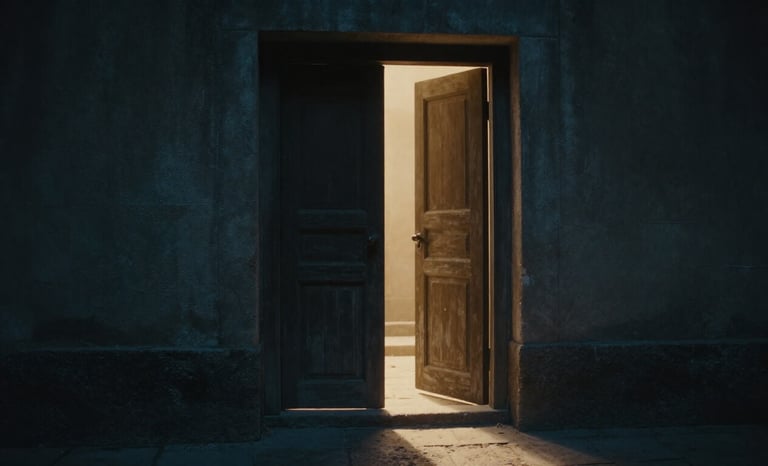
The door is open. Your heart is racing. Your stomach is dropping.
And somewhere beneath all the terror, if you listen closely, there's a quiet voice saying: "Yes. This one. Now."
What if you listened?
FAQ: Understanding Opportunity Paralysis
Q: Why do I freeze when good opportunities come up?
A: You're experiencing a freeze response, an automatic survival mechanism where your nervous system treats new opportunities as threats. When fighting or fleeing isn't possible, your brain defaults to immobility. This happens because your nervous system can't distinguish between "this will change me" and "this will harm me", both trigger identical survival responses involving shutdown of your prefrontal cortex and activation of your limbic system.
Q: Is freeze response the same as fear?
A: Not exactly. Freeze is a specific physiological state characterized by immobility, shallow breathing, and the thinking brain going offline while your survival brain takes over. It's one of three automatic stress responses (fight, flight, freeze). When it becomes your default response to opportunities rather than actual threats, it's called functional freeze, where you remain stuck even when there's no real danger present.
Q: How do I know if my fear is intuition or just anxiety?
A: Contraction fear (intuition saying no) feels depleting, heavy, and makes you want to escape, and once you've decided no, you feel relief and don't think about it again. Expansion fear (intuition saying yes) feels terrifying but magnetic, electric, alive, and if you say no, you can't stop thinking about it. The difference is directionality: danger makes you want to run away and forget about it; growth makes you want to run away but you keep being pulled back.
Q: What if I regret saying yes to an opportunity?
A: Research with dying patients shows people don't regret their failures, they regret their hesitations. The top regret is wishing they'd had courage to live authentically rather than safely. The pain of trying and failing is acute but temporary and builds resilience. The pain of never trying is chronic and intensifies over years. Embarrassment fades in days or weeks; regret compounds over decades.
Q: Why does my brain only focus on worst-case scenarios?
A: This is negativity bias, an evolutionary survival mechanism where your brain weighs negative information about five times heavier than positive information. Your ancestors who missed seeing one predator died; those who missed one opportunity to gather berries just tried again tomorrow. This asymmetry kept humans alive but now makes your brain overestimate social embarrassment and underestimate your capacity to handle failure.
Q: How can I build courage to take opportunities despite fear?
A: Start with the 5-4-3-2-1-MOVE technique: when you feel freeze starting, count backward and take immediate physical action on 1, send the email, make the call, say yes before your thinking brain catches up. Practice with low-stakes opportunities first to build the neural pathway. Use grounding techniques (feet flat, hands on belly, long exhales) to discharge freeze response. Remember: you don't build capacity by waiting until you feel ready; you build it by doing the thing while afraid.
Q: What's the difference between being realistic and being afraid?
A: Discernment asks: "Does this align with my values? Is this the right timing for me?" Fear asks: "But what if it goes wrong?" Realistic assessment weighs actual risks and resources; fear builds elaborate cases for why now isn't right, why you're not ready, why this particular opportunity isn't quite the right fit. Notice if you're being wise or if you're being terrified, fear often masquerades as wisdom.
Q: How long does it take to overcome the freeze response?
A: Freeze response is an automatic nervous system reaction that won't completely disappear, it's part of your survival wiring. However, you can rewire your habitual response through consistent practice. Each time you move through freeze instead of staying stuck, you strengthen new neural pathways. Start with small opportunities and build up. The goal isn't eliminating fear; it's learning to move while afraid and trusting yourself to handle what unfolds.
Your Next Opportunity Is Coming
Right now, as you finish reading these words, there's an opportunity somewhere in your life. Maybe it's already here, waiting for your answer, requiring your decision, asking if you're ready. Maybe it's on its way, approaching like a train you can either board or watch pass by from the platform.
You know the one I'm talking about. The thing that makes your stomach drop and your heart race. The possibility that terrifies and magnetizes you in equal measure. The door that's opening while your hand hovers, frozen, unable to reach for the handle.
Here's what I want you to understand: everything in this article, the neuroscience, the practices, the research, the warnings about regret, none of it matters if you don't use it the next time paralysis hits.
Reading about the freeze response doesn't rewire your nervous system. Understanding negativity bias doesn't automatically make you brave. Knowing the difference between contraction fear and expansion fear won't help if you don't check in with your body when the moment arrives.
The only thing that changes the pattern is what you do next time you feel the freeze beginning.
So here's your practice, starting now:
When the next opportunity arrives, and it will, I want you to notice the exact moment paralysis starts to grip you. Notice your breath getting shallow. Notice your mind spinning through catastrophic scenarios. Notice your body going still, your thoughts getting loud, your reasons for "not yet" piling up like evidence in a case you're building against yourself.
And in that moment, I want you to remember:
This feeling, this terror, might not mean stop. It might mean this matters profoundly to you.
The opportunities that change nothing don't make you freeze. The possibilities that don't align with your deepest becoming don't trigger this response. Your nervous system only activates this survival mechanism when something genuinely significant is at stake.
Which means the paralysis itself might be proof you're exactly where you need to be.
Not comfortable. Not easy. Not feeling ready.
But exactly where growth lives. Exactly where your life expands. Exactly where you become the person you're meant to become.
The Moment of Choice
Your 80-year-old self is watching this moment. They know how the story ends. They know what happens if you say yes and what happens if you freeze. They know which choice leads to the life fully lived and which choice leads to the quiet accumulation of "what ifs."
They're not judging you. They're just hoping, with everything they've learned about what truly matters, that you'll be brave enough to feel the fear and move anyway.
Because here's what they know that you're still learning: The embarrassment you're afraid of? It's already gone in their timeline. Forgotten. Irrelevant. But the regret? That one stayed. That one compounded. That one they're still carrying.
They wish they could reach back through time and tell you: Take the risk. Make the call. Send the email. Say yes. Walk through the door while your hands are shaking and your heart is pounding and every cell in your body is screaming that you're not ready.
You won't be ready. You'll do it anyway. And you'll survive. And you'll grow. And years from now, you won't remember the fear nearly as vividly as you'll remember the aliveness of choosing to become.
What If You Said Yes?
Just for a moment, let yourself imagine it.
Not the catastrophic version your fear has been rehearsing. Not the version where everything goes wrong and you're exposed as a fraud and everyone judges you and your worst nightmares come true.
The other version. The one where you say yes and you're terrified and you do it anyway and... you're okay. More than okay. You're more alive than you've been in years.
What if the person on the other side of that door, the one you're too afraid to become, is exactly who you've been looking for?
What if they're braver than you think? More resilient? More capable of handling discomfort, weathering failure, surviving embarrassment, and still showing up?
What if they're not waiting for you to feel ready? What if they're just waiting for you to move?
This Is Not Motivation. This Is Permission.
I'm not here to pump you up with empty affirmations or convince you that fear doesn't matter. Fear does matter. The stakes are real. You might fail. You might embarrass yourself. You might discover it wasn't the right fit after all.
All of that is true.
And also true: You will survive it. You will learn from it. You will become more because of it, not less.
What I'm offering isn't motivation. It's permission.
Permission to be terrified and do it anyway.
Permission to not have all the answers before you start.
Permission to try and fail and discover you're tougher than you knew.
Permission to disappoint your fear, which has been running your life by convincing you it's keeping you safe.
Your fear has been the loudest voice in the room for too long. It's had its turn. It's made its case. And its case is always the same: "Not yet. Not this. Not you. Too risky. Too scary. Too much."
But you, the awareness behind the fear, the one reading these words, the one who opened this article because some part of you knows you've been living smaller than you're meant to, you get a vote too.
And your vote counts just as much as fear's.
The Next Five Seconds
When the opportunity comes, and it's coming, you'll have approximately five seconds before your thinking brain catches up and starts building the case for no.
Five seconds before the freeze fully activates.
Five seconds before analysis paralysis takes over.
Five seconds to choose movement over safety.
I need you to use them.
5 - Notice you're at a crossroads
4 - Remember: this terror might mean it matters
3 - Feel your feet on the ground
2 - Take one breath
1 - Move
Send the email. Make the call. Say yes. Raise your hand. Step through the door.
Do it while your hands are shaking. Do it while your mind is screaming. Do it while every ounce of your conditioning is begging you to stay safe, stay small, stay familiar.
Do it anyway.
Because on the other side of that five-second window is either action or regret. Growth or stagnation. The life you're meant to live or the life you settled for because you were too afraid to reach for more.
You Already Know What to Do
If you've read this far, you know.
You know which opportunity I'm talking about.
You know what your expansion fear feels like versus your contraction fear.
You know the difference between wisdom and terror.
You know what your 80-year-old self would tell you to do.
You know.
The question was never "What should I do?"
The question is: "Will I do what I already know I need to do?"
Will you trust that the terror is data, not direction?
Will you choose the pain that leads somewhere over the pain that keeps you stuck?
Will you move before freeze wins?
This Is Your Moment
Not some perfect future moment when you feel ready.
Not when you have more skills or more confidence or more certainty.
Not when the fear is gone or the risk is smaller or the timing is better.
This moment. The one you're in right now. The one where opportunity is knocking and fear is screaming and you're frozen between who you've been and who you're becoming.
This is the moment.
And you, terrified, imperfect, not-quite-ready you, are enough for this moment.
You've always been enough.
The door is open.
Your heart is racing.
5... 4... 3... 2... 1...
Move.









© 2025. All rights reserved.
info@cosmiclifeflow.com