Sound Healing
The Science Behind Sound Healing
12/9/202513 min read
The Science Behind Sound Healing: Does It Really Work?
Between the frequency of a singing bowl and the firing of your neurons lives an ancient truth science is only beginning to measure.
You've felt it, that moment when a particular song shifts something inside you. The way a loved one's voice can calm your racing heart. How certain sounds make your whole body relax while others set your teeth on edge. We call this subjective, personal, even mystical. But what if I told you there's measurable science behind why sound moves through you like medicine?
Sound healing isn't New Age wishful thinking. It's physics meeting physiology, ancient wisdom validated by modern neuroscience. From the 40,000-year-old didgeridoos of Aboriginal Australia to the EEG machines measuring your brainwaves this very moment, humanity has known a secret: sound doesn't just move through space—it reorganizes matter, shifts consciousness, and can literally change the structure of your cells.
Let's explore what happens when vibration meets biology, when frequency encounters the 60% of you that is water, when the right sound finds the vagus nerve that connects your brain to your beating heart.
What Happens in Your Brain During Sound Healing
Your brain doesn't experience reality directly, it interprets electrical patterns. Right now, millions of neurons are firing in rhythmic waves, creating what scientists call brainwave frequencies. These aren't metaphors. They're measurable oscillations that determine whether you feel alert, creative, anxious, or deeply at peace.
This is not ancient mysticism, this is electroencephalography.
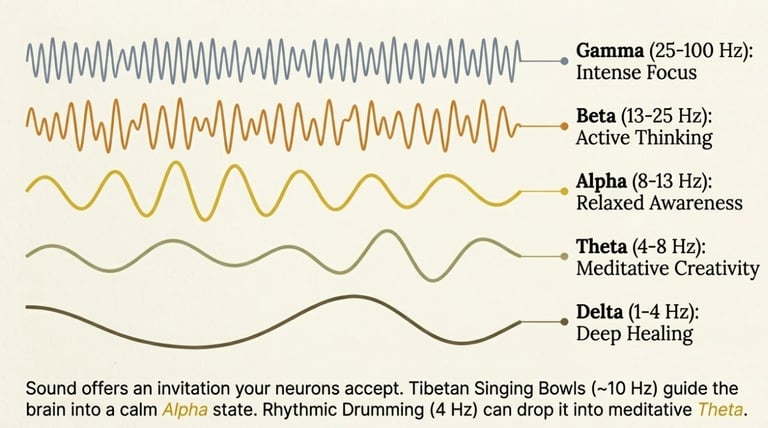
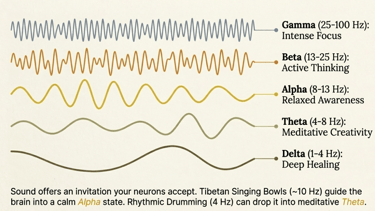
Researchers using EEG technology have mapped five distinct brainwave states, each operating at specific frequencies measured in Hertz (Hz). Delta waves (1-4 Hz) govern deep, dreamless sleep and healing. Theta waves (4-8 Hz) emerge during meditation, creativity, and the edge of sleep, what mystics call the "realm of subconscious knowing." Alpha waves (8-13 Hz) mark relaxed awareness, the state where you're calm yet focused. Beta waves (13-25 Hz) drive active thinking and problem-solving. Gamma waves (25-100 Hz) fire during moments of intense focus and insight.
Here's where it gets extraordinary: external sound can entrain these waves. When you listen to rhythmic drumming at 4 Hz, your brain begins to match that frequency, dropping into theta. Singing bowls resonating around 10 Hz can guide you into alpha's peaceful clarity. The sound doesn't force this change, it offers an invitation your nervous system accepts.
A 2017 study published in the Journal of Evidence-Based Complementary & Alternative Medicine examined 62 participants who experienced Tibetan singing bowl meditation. The results were striking: significant reductions in tension, anxiety, anger, and depression, with simultaneous increases in spiritual well-being and decreases in physical pain.
The mechanism is elegant. Research on music's impact on bioelectrical brain oscillations shows that different frequencies alter the power of specific brainwave bands, with music therapy decreasing slower wave activity while increasing faster waves in patients with traumatic brain injuries, essentially "waking up" dormant neural networks. Studies reveal that positively valenced music increases theta power in mid-frontal brain regions, the areas associated with emotional processing and memory. PubMed Central
Your brain, it turns out, is a sophisticated tuning fork.
The Vagus Nerve: Your Body's Sound Highway
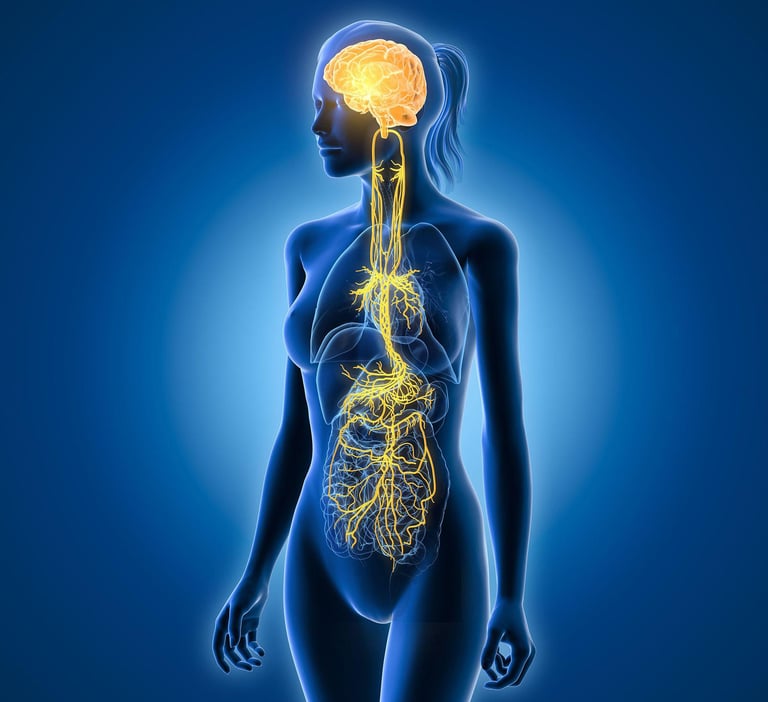
Beneath your conscious awareness, a wandering nerve snakes from your brainstem down through your chest and into your abdomen. The vagus nerve, from the Latin vagus, meaning "wandering", is the longest cranial nerve in your body, connecting your brain to your heart, lungs, and digestive system. It's the primary channel of your parasympathetic nervous system, the network that governs rest, digestion, healing, and the feeling of safety.
Nature speaks in patterns. The vagus nerve is one of them.
Sound therapy, particularly through resonant frequencies, can stimulate the vagus nerve, helping shift the body from a fight-or-flight state to one of social engagement or deep relaxation. This isn't speculation, it's the foundation of Polyvagal Theory, developed by neuroscientist Dr. Stephen Porges. His theory reveals how our sense of safety, danger, or life threat impacts our behavior through the vagus nerve, which processes signals from the world around us and determines how we react through three distinct physiological states.
Think of the vagus nerve as a two-way communication highway. Information flows from your organs up to your brain ("I feel a knot in my stomach") and from your brain down to your body ("Time to relax, slow the heartbeat"). Sound enters through your ears, vibrates the tiny bones of your middle ear, and stimulates neural pathways connected directly to this vagal network.
The Safe and Sound Protocol, developed by Dr. Porges, uses specially filtered music to stimulate the vagus nerve through the auditory system, fostering a sense of physiological safety. Studies confirm this approach significantly enhances heart rate variability, a key marker of autonomic regulation and stress resilience. PubMed Central
The vagus nerve passes through your vocal cords and inner ear, which means the vibrations of humming, chanting, or singing directly influence your nervous system states. This is why monks have chanted "Om" for millennia. Why gospel singers experience transcendence. Why humming a lullaby calms both the singer and the listener. The ancients didn't have EEG machines, but they understood: certain sounds fundamentally shift how safe your body feels in the world.
When you're chronically stressed, your sympathetic nervous system dominates, heart racing, breath shallow, digestion stalled. Sound healing offers a doorway back to balance. The right frequencies activate the ventral vagal complex, the evolutionarily newest branch of your vagus nerve, which Dr. Porges calls the "social nervous system." Research demonstrates that sound therapy significantly enhances our ability to switch into calming social engagement pathways, which is only possible when autonomic stress levels have been regulated by the myelinated vagus nerve.
You are not separate from vibration. You are woven from it.
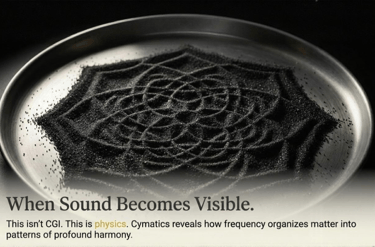
Cymatics: When Sound Becomes Visible
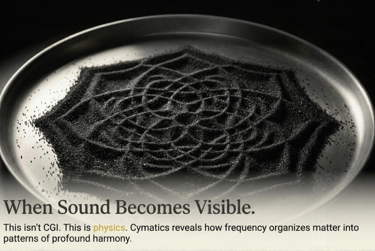
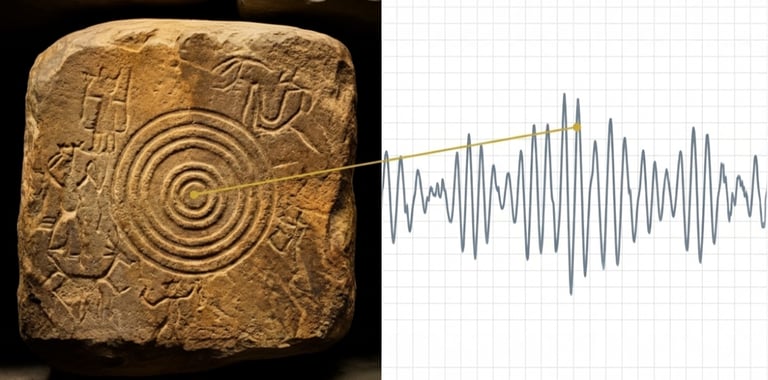
If you want to watch magic that's actually physics, scatter sand across a metal plate and run a violin bow along its edge. The sand will suddenly leap into geometric patterns, circles, stars, mandalas of impossible symmetry. Change the frequency, and the pattern instantly transforms. This is cymatics: the study of visible sound.
Swiss physician Hans Jenny, who coined the term cymatics in 1967, subjected various substances, sand, powder, water, oils, even molten plastic, to oscillating sound waves and photographed their dramatic shape transformations as frequencies changed. Using sine wave generators and crystal oscillators, Jenny documented how specific frequencies create intricate geometric patterns that reflect universal forms found throughout nature and living organisms.
The patterns aren't random. Jenny discovered that high-pitched frequencies produced complex, harmonious, geometric, and symmetrical shapes, while lower frequencies created less complex and more disharmonious forms. The same physics that creates snowflakes and nautilus shells also governs how sound organizes matter.
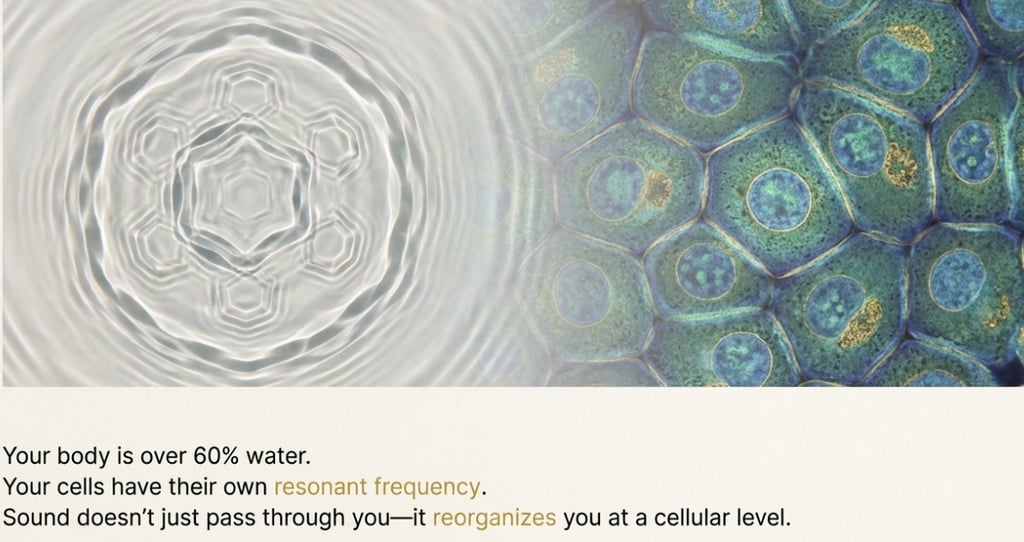
Now consider: your body is 60-75% water. Your brain is 75% water. Cymatics photographer Alexander Lauterwasser demonstrated that water exposed to different frequencies takes on dramatically different molecular structures, with higher frequencies creating more intricate patterns. Some researchers propose that water has "memory" and can store information from sound vibrations, suggesting that sound healing could leave lasting effects on the body.
Between matter and energy lives sound, the bridge between what is and what could be.
Hans Jenny speculated that every cell has its own frequency, and that cells with the same frequency create harmonious new frequencies, potentially explaining how organs maintain coherent function. He proposed that understanding how different frequencies influence genes, cells, and body structures holds the key to healing through sound.
This isn't merely theoretical. British osteopath Dr. Peter Guy Manners spent decades researching vibrational codes for the human body, eventually identifying approximately 750 specific frequency combinations for restoring tissues, organs, glands, and bones. His "Cymatherapy" achieved what many considered miraculous results, continuing until his retirement at age 101.
Every thought you think, every emotion you feel, every breath you take creates vibration. The question isn't whether sound affects you. The question is: which sounds will you choose?
Ancient Wisdom, Modern Validation
For 40,000 years, long before written language, before agriculture, before civilization as we know it, humans have known sound heals. Archaeological evidence reveals that Aboriginal Australians used the didgeridoo as a healing instrument for at least 40,000 years, making it the oldest known therapeutic sound tool. They didn't have peer-reviewed journals, but they had direct experience, passed down through countless generations.
Ancient Egypt integrated music so deeply into healing that medical papyrus texts describe chant-like incantations for treating illness, and the sistrum, a ritual rattle, generated what we now recognize as ultrasound frequencies for therapeutic purposes. Egyptian high priestesses understood that seven vowels created sacred sounds with harmonic convergence, and they believed so profoundly in sound's power that they included no vowels in hieroglyphic writing, sound was too sacred to capture in static symbols.
The ancient Greeks built healing chambers designed for "dream sleep" therapy, incorporating reverberant surfaces and parallel stone walls that amplified musical instruments for therapeutic effect. They recognized what neuroscience now confirms: architecture and acoustics together create healing environments. Greek physicians used flutes, lyres, and zithers to heal patients, employing vibration to aid digestion, treat mental disturbance, and induce sleep.
Pythagoras, whom history remembers for mathematics, was equally devoted to music's healing properties. He wrote that "each celestial body, in fact each and every atom, produces a particular sound on account of its movement, its rhythm or vibration", an insight quantum physics would eventually validate. Aristotle, in his work De Anima, documented that flute music could arouse strong emotions and purify the soul. (NCBI)
The ancient Indians encoded healing into language itself. Vedic mantras were designed as precise sound technologies, intended for oral transmission only because writing them "robbed them of their true essence." The belief was clear: even without understanding the meaning, the sound's design created direct connection with cosmic elements and consciousness itself.
This wasn't superstition. It was sophisticated understanding of how vibration interfaces with biology. Every ancient civilization, Aboriginal Australian, Egyptian, Greek, Vedic Indian, Chinese, Tibetan, Mesopotamian, Incan, developed sound healing practices independently. They used different instruments, different frequencies, different cultural frameworks. But they all arrived at the same truth: sound is medicine.
Science doesn't replace this wisdom. Science explains it.
The Mechanisms: How Sound Actually Heals
Let's ground mysticism in mechanism. When singing bowls ring at frequencies around 110-660 Hz, several measurable physiological changes occur simultaneously:
First, brainwave entrainment. As sound therapy continues, the brain's electrical patterns synchronize with external frequencies, achieving the specific frequency level of that sound, whether alpha, theta, or delta. This isn't hypnosis; it's resonance. Your brain naturally seeks coherent patterns, and when offered a steady rhythmic frequency, neural networks begin to oscillate in harmony with it.
Second, nervous system regulation. Sound healing activates the parasympathetic nervous system and triggers the relaxation response, lowered blood pressure, reduced heart rate, and a state that counters fight-or-flight activation. PubMed Central The mechanism involves stimulation of the vagus nerve through auditory pathways, which then signals the brainstem to shift autonomic states. Research on anxiety disorders shows that deliberately increasing alpha and theta brain waves in specific regions through neurofeedback (including sound therapy) significantly reduces symptoms of generalized anxiety disorder and improves global functioning. PubMed Central
Third, cellular resonance. Every cell membrane vibrates. When external vibrations at healing frequencies interact with cellular structures, they can restore optimal oscillation patterns. Cymatic therapy devices, including gongs, singing bowls, didgeridoos, and drums, produce vibrations that interact with the body's cells, encouraging them to resonate at their natural, healthy frequencies. This process helps restore balance and homeostasis within the body.
Fourth, inflammation modulation. Recent studies reveal the vagus nerve's key role in regulating inflammation, mood, and pain. Vagal stimulation through sound therapy activates the body's anti-inflammatory pathways.
Fifth, neuroplasticity enhancement. Neural connections strengthen and new pathways form through repeated sessions of multisensory input, allowing the nervous system to adapt and find safety or homeostasis more quickly and easily.
A 2006 retrospective analysis of 159 fibromyalgia patients treated with three-phase Sound Resonance Technology Therapy showed average decreases of 26-38 points on the Fibromyalgia Impact Questionnaire, with researchers noting that "no other therapy reported in the scientific literature seems as efficacious for fibromyalgia." PubMed A separate study found that spontaneous harp music significantly decreased ICU patients' pain perception by 27%. PubMed
These aren't placebo effects or wishful thinking. These are measurable, repeatable, biological responses to specific acoustic frequencies.
Science doesn't yet know everything about how sound heals. But this much is certain: it does.
What This Means for You
Understanding the science behind sound healing doesn't diminish its power, it amplifies it. You don't need to choose between rationality and wonder. The data invites both.
You carry within you a sophisticated instrument: a nervous system that responds to vibration, a brain that synchronizes with rhythm, cells that resonate with specific frequencies, and a vagus nerve that connects your consciousness to your body's deepest wisdom. Sound healing works because you are fundamentally a vibrational being existing in a vibrational universe.
The question is not whether sound healing works, decades of research across neuroscience, psychophysiology, and clinical medicine confirm that it does. The question is: how will you use it?
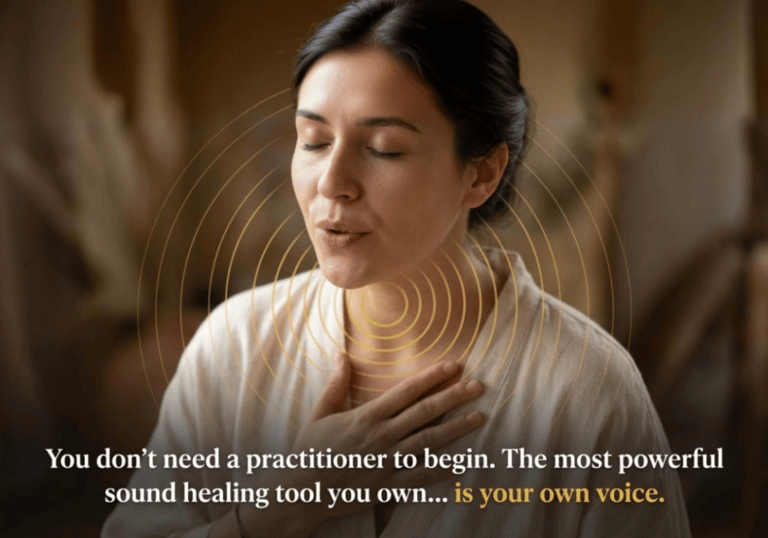
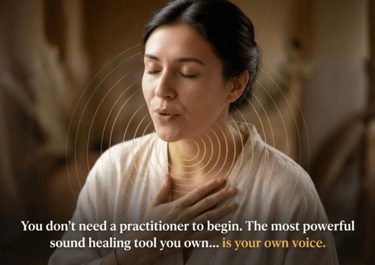
You don't need expensive equipment or specialized training to begin. Your own voice is the most accessible sound healing tool you possess. Humming stimulates the vagus nerve because it passes through your vocal cords and inner ear, making humming a free and easy way to influence your nervous system. Five minutes of humming while focusing on the vibrations in your chest and throat can shift you from stress to calm.
Conscious breathing activates similar pathways. When breath slows from the typical 10-14 breaths per minute to 5-7 breaths per minute, significant vagus nerve stimulation occurs. Adding a slight throat constriction to create an "hhh" sound further enhances the effect.
If you're drawn to deeper practice, research shows that singing bowl sound meditation can produce physiological and psychological benefits by reducing negative affect, increasing positive emotions, and improving blood pressure and heart rate. The practice helps balance chakras and promotes energy flow through the body. ScienceDirect Importantly, sound healing requires no steep learning curve or discipline, participants simply lie down and receive the vibrations, making it accessible to anyone seeking stress relief. PubMed Central
The mechanisms are real: frequency entrainment, vagal stimulation, cellular resonance, brainwave harmonization. The effects are measurable: reduced anxiety, decreased pain, improved sleep, enhanced emotional regulation, greater spiritual connection. The invitation is ancient: cultures across 40 millennia have known that sound is medicine.
Now you know why.
You are not separate from the vibrations that created galaxies and sculpted mountains. You are made of the same oscillating energy. Sound healing doesn't add something foreign to your system, it reminds your cells of their original frequency. It calls you home to your own resonance.
The science behind sound healing reveals what the ancients intuited: we are symphonies temporarily playing ourselves into human form. Every heartbeat is percussion. Every breath is wind. Every thought creates waves. When we consciously work with sound, whether through singing bowls, humming, music, or sacred silence, we're not doing something mystical or separate from our biology. We're using physics to realign with the fundamental frequencies of health, balance, and wholeness.
Science and spirituality converge here, in the vibration that moves through everything. Between evidence and experience lives sound, the bridge that needs no translation because it speaks the oldest language of all: the frequency of being itself.
Frequently Asked Questions
Q: How long does it take for sound healing to show results?
Research participants experienced significant reductions in tension, anxiety, and pain immediately following a single sound bath session, with those new to the practice showing even greater benefits. While immediate effects are common, sustained practice strengthens neural pathways and autonomic regulation over time. Most practitioners recommend regular sessions over weeks or months for lasting neuroplastic changes.
Q: Can I do sound healing on my own, or do I need a practitioner?
Both approaches work. Professional sessions offer curated frequencies and immersive experiences, but self-practice is highly effective. Your voice, through humming, chanting, or toning, directly stimulates your vagus nerve. Listening to specific frequencies at home, conscious breathwork with sound, and even playing recordings of singing bowls can create measurable physiological shifts. The key is consistency rather than complexity.
Q: Is sound healing scientifically proven, or is it placebo?
Double-blind studies using EEG measurements, blood pressure monitoring, and validated psychological assessment scales demonstrate statistically significant changes in brainwave patterns, autonomic function, and mood states following sound therapy. Research using quantitative EEG shows that music therapy measurably alters the ratio of brain wave frequencies, increasing beneficial patterns and decreasing problematic ones in patients with various conditions. While expectation may enhance effects, the physiological mechanisms, brainwave entrainment, vagal stimulation, cellular resonance, operate regardless of belief.
Q: What frequency should I use for healing?
Different frequencies serve different purposes. Alpha waves (8-12 Hz) are associated with relaxed yet alert states, good moods, and the ability to learn effectively. Theta waves (4-8 Hz) connect to intuition, creativity, deep relaxation, and emotional healing. Delta waves (1-4 Hz) govern deep sleep and physical restoration. Rather than chasing specific numbers, focus on how sound makes you feel. If it creates calm, openness, or gentle energy shifts, your body is responding positively.
Q: Can sound healing help with chronic pain or illness?
A study of 159 fibromyalgia patients showed substantial symptom relief through sound therapy, with researchers noting effectiveness beyond other documented treatments. ICU patients experienced a 27% reduction in pain perception from live harp music. Sound healing doesn't replace medical treatment but works synergistically with it. The vagus nerve's role in regulating inflammation, pain, and mood makes sound therapy a valuable complementary approach for chronic conditions. Always consult healthcare providers about integrating sound healing with existing treatments.
In the Beginning Was the Word
Every creation myth humanity has ever told begins with sound. "Let there be light," spoken into void. "Om," the vibration that births universes. "In the beginning was the Word." We've always known: before matter, there was frequency. Before form, there was vibration. Before you became this particular arrangement of cells and story, you were sound, fundamental, formless, infinite. Sound healing isn't a return to primitive thinking. It's a return to fundamental truth, now validated by instruments sensitive enough to measure what ancient peoples could only feel. The EEG confirms what the yogi knew: certain sounds shift consciousness. The vagus nerve research explains what the shaman practiced: vibration heals. Cymatics makes visible what the mystic saw: frequency creates form. You are both the scientist and the subject, the observer and the observed, the instrument and the song. Between the first "Om" chanted in a cave 40,000 years ago and the singing bowl research published last month lives an unbroken lineage of humans discovering the same truth: we are made of music, and music can remake us. Not metaphorically. Actually. Measurably. Miraculously. This is the science behind sound healing. This is also the soul of it. They were never separate. Like frequency and form, like vibration and matter, they are the same thing, just different ways of listening.




© 2025. All rights reserved.
info@cosmiclifeflow.com