
reprogram subconscious mind during sleep
Can you really change limiting beliefs during sleep? Modern sleep science and ancient wisdom reveal how hypnagogic states reprogram the subconscious.
3/31/202614 min read


Can You Actually Reprogram Your Subconscious Mind While You Sleep?
You climb into bed exhausted, mind racing with the same worries that circled yesterday and the day before. By morning, despite eight hours of unconsciousness, you wake to find the same limiting beliefs waiting for you like unwelcome house guests. The thought patterns you promised yourself you would change feel permanently etched into your psyche, unchangeable as stone.
What if those nightly hours of darkness held a key you have been overlooking? What if your sleeping mind, far from being passive downtime, represents your most receptive state for genuine transformation?
Modern neuroscience and ancient wisdom converge on a startling truth: the threshold between waking and sleeping may be the most powerful window for subconscious reprogramming your brain naturally offers.
What Modern Sleep Science Reveals About Subconscious Receptivity
Your brain does not simply power down when you sleep. Research from institutions including Yale School of Medicine confirms that sleep functions as an active systems consolidation process, where memories undergo transformation and integration across different brain regions through repeated neuronal replay. The architecture of your sleep cycles creates distinct neurochemical environments, each serving different aspects of memory processing and neural reorganization.
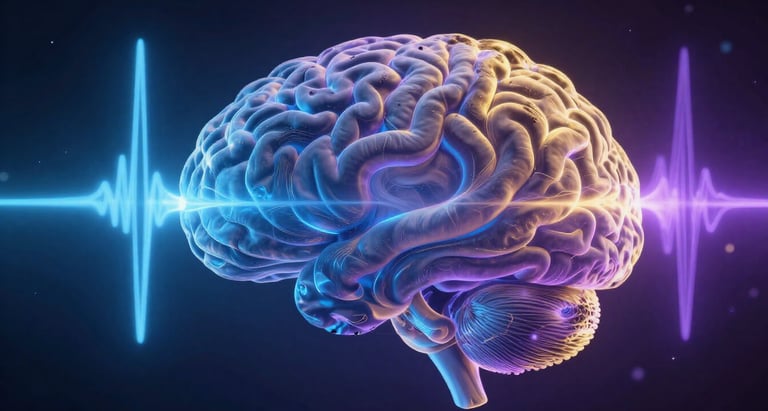
The hypnagogic state, that drifting in-between moment when wakefulness dissolves into sleep, produces a unique blend of alpha and theta brain waves. Studies documented in PMC's research on the hypnagogic state show that theta activity, ranging between 4 and 8 Hz, marks the sweet spot where your prefrontal cortex, the executive control center responsible for critical thinking and filtering information, significantly reduces its activity.
The twenty to thirty minutes before sleep represents a natural gateway into theta, when input delivered to your mind has access to the subconscious in its most receptive state. During this window, the evaluating, rejecting, analyzing gatekeeper of your conscious mind relaxes its grip. During slow wave sleep particularly, hippocampal replay drives consolidation by capturing episodic memory aspects and transforming them through synaptic plasticity mechanisms. Your brain literally rewires itself based on what occupied your mental space before you drifted off.
This is not metaphysical speculation. The implications for intentional transformation become clear: your sleeping brain is not merely processing yesterday's experiences. It is actively constructing tomorrow's neural architecture, and the inputs you provide as you cross the threshold into sleep shape which connections strengthen and which dissolve.
The Ancient Temple Practice of Dream Incubation
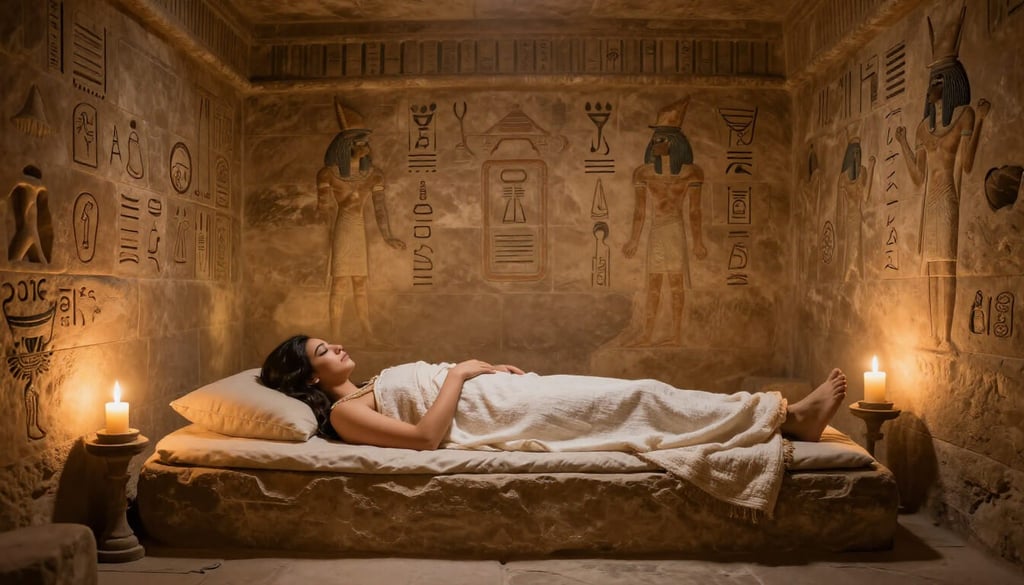
Thousands of years before electroencephalograms measured theta waves, ancient civilizations understood that sleep represented a portal to transformation. Egyptian dream temples, also known as incubation chambers, served as early wellness centers where patients underwent purification rituals, fasting, and prayers before sleeping in unlit chambers specifically designed for healing through dreams.
During sleep in these sacred precincts, the gods, particularly Serapis or Imhotep, were believed to visit and provide solutions either through symbolic dreams or direct healing. Temples dedicated to goddesses like Isis often served as centers for this dream incubation practice. The process involved chanting to place patients into trance like states, analyzing their dreams upon waking to determine treatment protocols.
These sleep temple methods prevailed for thousands of years across Egyptian, Greek, and Roman civilizations, with countless testimonies and votive offerings proclaiming successful treatment. The Greek Asclepieions, temples dedicated to Asklepios the healing god, systematized this approach further.
Those seeking healing traveled hundreds of miles to reach such temples, working through periods of fasting and purification, taking part in invocation rituals, drinking water from holy mineral rich springs, and observing devotional customs before finally lying upon a sacred skin called a kline, from which we derive the word clinic, to await curative dreams.
In the main temple chamber, seekers would unroll their sacred skin in alcoves to sleep and dream of god Asclepius healing them, with attendants helping them explore the dream upon waking and secure insights appropriate to their stage of development.
What the ancients intuited parallels what modern sleep research confirms: the restorative nature of sleep extends far beyond physical repair to encompass emotional and spiritual wellbeing, with the threshold states serving as portals for genuine transformation.
The ritual structure these traditions employed optimized the hypnagogic state. Purification created mental clarity. Intention setting before sleep directed the focus of subconscious processing. The sacred environment signaled to the nervous system that this sleep held special significance, activating heightened receptivity.
Yoga Nidra: The Yogic Science of Conscious Sleep
Yoga nidra, meaning yogic sleep, describes a state of consciousness between waking and sleeping, with roots in ancient yogic and Tantric traditions where it was first linked to meditation in Shaiva and Buddhist tantras as a state accessing secret knowledge.
Unlike the Egyptian practice of unconscious dreaming for divine messages, yoga nidra maintains a thread of awareness through the sleep transition. Ancient yogis described it as sleep with full awareness, where the body rests like in deep sleep but consciousness remains alert and receptive.
The practice involves eight distinct stages: preparation in Shavasana pose, setting a sankalpa or personal resolution, systematic rotation of awareness through body parts, breath awareness, exploration of sensory pairs of opposites, mental visualization, return to sankalpa, and gradual reawakening.
The sankalpa represents yoga nidra's most transformative element. During this practice, the mind knowingly experiences different brainwave levels receptive to change including alpha, theta, and delta frequencies. When a resolve is implanted in this state, the subconscious mind absorbs it more quickly than during normal waking consciousness.
The sankalpa made at the beginning of practice is like sowing a seed, while the sankalpa at the end is like irrigating it. The resolution gathers the vast forces of the mind to bring fruition once planted deep in the subconscious. The directive must be short, clear, positive, and stated in present tense, as if already true.
Ancient yogic philosophy understood that theta waves connect to the subconscious, governing the part of mind between conscious and unconscious that contains suppressed fears and desires, memories and sensations, serving as the gateway to learning and memory.
The wisdom was not that sleep itself transforms. The wisdom was that the liminal state, that threshold space where awareness persists while the body enters rest, becomes the crucible for reformation. The ancient yogis called this chitta, the storehouse of impressions, and understood that accessing it during the threshold state allowed for the planting of new seeds that would flower in waking consciousness.
The Hermetic Principle: As Above So Below, As Within So Without
Hermetic philosophy, rooted in teachings attributed to Hermes Trismegistus who synthesized elements of Greek god Hermes and Egyptian god Thoth, encompasses esoteric knowledge influencing various mystical and occult traditions. The core doctrine asserts that the universe emanates from a single divine Mind.
The first Hermetic principle, Mentalism, declares that all is mind. This teaching reveals that consciousness is not merely an observer of reality but an active participant in shaping it. Your mind functions as a microcosm of the Divine Mind, capable of creation, insight, and transformation.
Within this framework, sleep takes on profound significance. If consciousness shapes reality, and if the subconscious mind holds vastly more influence over your automatic patterns than the conscious mind, then accessing the subconscious during its most receptive state becomes the ultimate alchemical work.
Hermetic philosophy taught that our thoughts and feelings are the thoughts and feelings of the whole universe, generating deep insight into the structure of mind. Alchemists believed they could transform a dark leaden mind into a shining golden one through universal operations.
The famous Hermetic maxim, "As above, so below; as within, so without," encoded a practical instruction: while All is in The All, it is equally true that The All is in All, meaning the intelligence of universal mind exists not only outside us but within us.
Your inner world, including the contents of your subconscious mind, creates your outer world of experience. The night, the time of darkness and descent into unconscious realms, represented the inner temple where transformation occurred.
Hermetic alchemists understood that the Great Work was not merely physical transformation of metals but psycho spiritual transformation. Archetypal forces penetrating to the soul truly change practitioners from inside out, engendering deep connection with the eternal.
Sleep, in this tradition, was the nightly death and rebirth. Each time you crossed the threshold into unconsciousness, you entered the below, the hidden realm. What you carried with you into that darkness, what intentions and images occupied your awareness as consciousness dissolved, determined what would be forged in the night's alchemical furnace.
The Hermetic understanding recognized three levels of consciousness: the conscious waking mind, the subconscious realm accessed through liminal states, and the superconscious or divine mind. Sleep provided the bridge between these levels, the time when the barriers thinned and intentional work could reach from the conscious into the subconscious to plant seeds that would grow in the fertile darkness.
Sufi Dream Work and the Heart's Night Language
The Sufi mystics approached sleep and dreaming through the lens of the heart. In Islamic mystical tradition, the qalb, the heart, functions as the organ of spiritual perception, the receiver of divine inspiration.
Before sleep, Sufi practitioners would engage in muraqaba, a form of meditation focused on cultivating presence and receptivity. This practice prepared the heart to receive insights during the dream state, purifying intention so that sleep became an extension of spiritual practice rather than mere rest.
The Sufis understood that the sleeping heart speaks a different language than the waking mind. Dreams were not random neural firings but messages from the soul, communications from deeper dimensions of consciousness. The quality of your waking consciousness, particularly in the hours before sleep, determined the quality of these nocturnal communications.
By entering sleep in a state of dhikr, remembrance of the divine, practitioners ensured their subconscious processing aligned with their highest aspirations. The heart, already tuned through meditation, remained receptive to guidance even as the rational mind dissolved into sleep.
This tradition recognized what modern psychology would later articulate: the subconscious does not distinguish between imagination and reality, between symbolic and literal truth. The images and intentions held as you drift into sleep become the raw material for overnight neural restructuring.
The Sufi poet Rumi wrote of sleep as a practice of dying before death, a nightly rehearsal for the ultimate dissolution. In this understanding, the threshold between waking and sleeping mirrored the threshold between life and what lies beyond. To approach sleep consciously was to practice approaching all transitions with awareness and intention.
Three Ancient Inspired Practices You Can Use Tonight
These practices distill thousands of years of wisdom into accessible techniques you can implement immediately. Each works with the natural receptivity of your hypnagogic state, that precious window where conscious and subconscious minds overlap.
Practice 1: The Egyptian Dream Incubation Ritual (5 minutes)
Begin with purification. Wash your hands and face with cool water, not as mere hygiene but as a ritual cleansing of the day's accumulated mental debris. As you dry your skin, set the intention to also dry away scattered thoughts and anxieties.
Write your question or intention on paper in simple, clear language. This could be a problem requiring solution, a quality you wish to cultivate, or a decision needing clarity. Place the paper under your pillow, a physical anchor for your mental focus.
Lie facing east, the direction of rising consciousness and new beginnings. As you settle into stillness, speak your intention aloud three times, then release it completely. Trust the night to do its work.
Practice 2: Yogic Sankalpa Planting (3 minutes)
Lie in Shavasana, corpse pose, with palms facing upward and limbs not touching. Allow your body to become completely still, as if you have already entered sleep.
Formulate your sankalpa using these criteria: present tense, positive phrasing, short enough to remember easily. Examples include "I am calm and resilient," "My body heals effortlessly," or "I trust my inner knowing."
As you feel yourself beginning to drift, that unmistakable sensation of consciousness starting to dissolve, repeat your sankalpa internally three times with full conviction. Visualize yourself already embodying this truth, feeling the reality of it in your body. Then let it go, allowing sleep to carry you forward while the seed plants itself in receptive soil.
Practice 3: Hermetic Threshold Meditation (10 minutes)
Sit in darkness before bed with a single candle burning. The flame represents the bridge between conscious and subconscious, visible and invisible, above and below.
Focus on the flame without strain, allowing its light to fill your awareness. As thoughts arise, watch them pass like shadows flickering on a wall. The flame remains constant while everything else moves.
When you feel centered and still, speak your desired transformation aloud to the flame. Use present tense: "I am" rather than "I will be." The power lies in claiming the reality now, in this liminal moment.
Extinguish the flame consciously, watching the smoke rise as the light disappears. Carry that intention, now sealed in darkness, directly into sleep. Do not engage in any other activity between this practice and lying down.
The Tools That Support Subconscious Transformation
Your subconscious mind can only reorganize itself effectively when your body provides the biological foundation for deep, restorative sleep. The consolidation process that integrates new patterns requires specific conditions including slow wave sleep and proper neurochemical environments that facilitate communication between hippocampus and neocortex.
Sleep quality determines whether the intentions you set actually take root or dissolve like morning mist. When your sleep architecture is fragmented, when you never reach the deeper stages where theta transitions to delta, the transformative work cannot occur.
This is where 4GreatSleep becomes relevant not as a sleep aid that forces drowsiness, but as targeted nutritional support addressing the root causes that prevent natural sleep cycles from functioning optimally. The formula combines melatonin to regulate your sleep wake cycle, GABA to quiet mental chatter, magnesium to relax tense muscles, and L tryptophan to boost serotonin production, providing your brain with the raw materials it needs to naturally produce sleep regulating compounds.
By supporting your body's innate ability to fall asleep easily and move through complete sleep cycles, you create the conditions where theta state access becomes reliable rather than occasional. The transformation techniques described in this article require a foundation of genuine restorative sleep to be effective.
What distinguishes this approach from pharmaceutical solutions is its alignment with your body's natural processes. Rather than forcing your brain into artificial unconsciousness, quality sleep support helps restore the biochemical balance that makes effortless sleep your default state again.
What the Ancients Knew That We Forgot
Modern culture treats sleep as inconvenient downtime, dead hours subtracted from productivity. The ancients viewed sleep as sacred work, the most important work.
They understood that the threshold states, those moments of transition between waking and sleeping, held extraordinary power precisely because the ordinary boundaries dissolved. In those liminal spaces, divine and human, conscious and unconscious, possibility and actuality merged.
The temple sleep chambers, the yoga nidra practices, the Hermetic midnight meditations, all pointed toward the same truth: transformation does not occur through force. Transformation occurs through receptivity. The conscious mind cannot will itself into fundamental change. But the subconscious, when accessed in its native language during its most receptive state, reorganizes patterns with elegant efficiency.
We have not lost the capacity for this work. The biology remains identical. The theta states still arrive nightly. What we lost was the understanding that sleep required preparation, that the last thoughts before unconsciousness mattered immensely, that the liminal threshold held transformative potential.
You are reclaiming an ancient birthright each time you consciously work with your hypnagogic state. Millions of humans across thousands of years accessed this same neural gateway, planted the same seeds of intention, and woke transformed by morning light.
The techniques have survived because they work. Not because ancient peoples were naive or superstitious, but because they paid attention to what modern busyness has obscured: the sleeping mind listens, remembers, and rebuilds.
Frequently Asked Questions
How long does it take to reprogram the subconscious mind during sleep?
Neuroplasticity, your brain's ability to form new neural connections, occurs continuously. A single night of theta state intention setting can shift immediate perspective, but lasting transformation typically requires consistent practice over two to four weeks. Think of it as compound interest for consciousness: each night's work builds on previous nights, with changes accelerating as new patterns become default pathways. The ancient traditions understood this, which is why temple sleep often involved multiple nights and yoga nidra was practiced daily rather than occasionally.
Can I use affirmations while sleeping, or do I need to be semi awake?
The hypnagogic state, that semi awake threshold, provides the optimal window. Once you are fully asleep, conscious awareness dissolves and you cannot deliberately repeat affirmations. The power lies in the last moments before unconsciousness, when you can still hold intention while your critical mind has released control. This is why the practices described above emphasize the transition period rather than deep sleep itself. The ancient yogis called this the sandhya, the twilight zone between states.
What is the difference between sleep reprogramming and regular dreaming?
Sleep reprogramming works primarily with the hypnagogic and theta states before you enter full REM cycles, consciously directing your subconscious focus rather than passively receiving whatever content arises. You are providing specific input as the gate between conscious and unconscious opens, rather than simply observing what emerges once you are already asleep. Regular dreaming processes the day's experiences without conscious direction. Intentional reprogramming plants seeds that dreaming then nurtures.
Do I need to remember my dreams for subconscious reprogramming to work?
No. The subconscious processing continues whether you recall dreams or not. What matters is the input you provide as you enter sleep, not your memory of the overnight journey. Many people who practice these techniques notice changes in behavior and perspective without ever recalling specific dream content. The transformation occurs in the deep structure of consciousness, not in the narrative content accessible to waking memory.
Is it safe to try to influence my subconscious mind while sleeping?
When approached with clear, positive intentions aligned with your genuine values and wellbeing, working with your hypnagogic state carries no inherent risks. The key is using affirmations and intentions that support your growth rather than attempting to force artificial changes that conflict with your authentic self. Your subconscious has wisdom; it will not integrate suggestions that fundamentally contradict your core nature. The ancient traditions emphasized purity of intention for this reason.
Conclusion
Your subconscious mind has been listening all along. Every night as you drift toward sleep, a window opens. The question is not whether you can reprogram your deeper patterns through this threshold state. The question is whether you will use the opportunity consciously or let it pass by default.
The ancients who slept in temple chambers knew something we are remembering: transformation is not always loud. It does not require force or struggle. Sometimes the most profound changes occur in whispers, in the quiet moments when conscious resistance dissolves and deeper truth can finally be heard.
You are not powerless against the limiting beliefs that greet you each morning. You have access, every single night, to the same neural gateway that mystics and healers have used for millennia. The theta state does not discriminate. It offers its receptivity to everyone who crosses the threshold between waking and sleeping.
Tonight, as you prepare for sleep, you can simply collapse into unconsciousness. Or you can pause at the edge of that familiar darkness, plant a seed of intention, and trust your sleeping mind to do what it does best: reorganize, integrate, and rebuild according to the blueprint you have provided.
The transformation begins when you realize that falling asleep is not the end of your day's work. It is the beginning of your night's most important labor. Your subconscious stands ready, waiting for instructions you provide in that sacred liminal moment before consciousness dissolves.
What will you tell it tonight?










The products featured here are affiliate recommendations we've carefully selected. When you purchase through our links, we may earn a small commission at no extra cost to you, helping us create free content to support your journey. We only share what we truly believe can help.
© 2025. All rights reserved.
info@cosmiclifeflow.com