
How Can Journaling Become a Portal to Self-Discovery?
Journaling for self-discovery: the neuroscience, ancient wisdom, and 5 practical techniques that turn a blank page into a portal to know yourself.
3/3/202611 min read


How Can Journaling Become a Portal to Self-Discovery?
You sit down with a blank page. You pick up the pen. And then... nothing. Or worse, something: the same looping thought you had yesterday, the one from last week, the one you've been carrying so long it has started to feel like a personality trait rather than a problem. You write it down and feel vaguely embarrassed. Is this journaling? you wonder. Am I doing it wrong?
Here's what most people misunderstand about the practice: journaling is not about recording events. It is not a diary of what happened. It is an encounter with the part of you that doesn't have airtime during the regular rush of the day. When you write about your inner world without an audience, without performance, without needing to make sense for anyone else, something shifts. The page becomes a mirror that doesn't lie.
The truth is simple: journaling works because writing forces a different kind of thinking. The act of translating experience into language engages your prefrontal cortex in a way that replaying memories in your head never does. This is the portal. Not the beautiful notebook. Not the perfect prompt. The willingness to write what is actually there.
The Neuroscience of Writing Yourself Into Clarity
In 1986, Dr. James Pennebaker at the University of Texas at Austin ran an experiment that would quietly reshape how psychologists understood the relationship between language and emotional health. He asked college students to write about their deepest thoughts and feelings around a personal trauma for 15 minutes a day, four days in a row. The control group wrote about neutral topics. Six months later, the students who wrote about their emotional experiences visited the student health center at roughly half the rate of the control group. The findings, published in the Journal of Abnormal Psychology, suggested something radical: putting painful experiences into words was not just cathartic. It was physiologically protective.
Pennebaker described the mechanism as "inhibition and confrontation." When we suppress difficult emotions, the suppression itself costs energy. The nervous system stays on low-level alert, like a program running in the background consuming battery. Writing the experience out in structured language appears to help the brain reorganize the event, assign it a narrative arc, and release the physiological load of carrying it unprocessed.
Twenty years after Pennebaker's initial study, neuroscientist Dr. Matthew Lieberman at UCLA gave us the brain-scan evidence that explains why. In a 2007 fMRI study published in Psychological Science, Lieberman showed participants emotionally charged images while measuring their brain activity. When participants simply named what they were feeling, the amygdala, the brain's alarm system, became significantly less active. The right ventrolateral prefrontal cortex, the region associated with emotional regulation, increased in activity and appeared to directly dampen the amygdala's response. The clinical term is "affect labeling." The lived experience is what every person who journals already knows: naming something takes some of its power away.
This is why journaling about a conflict at work feels different from replaying it in your head. Rumination loops inside the emotional brain. Writing routes the experience through language centers, which sit inside the rational brain. You are not revisiting the event. You are translating it. And translation, it turns out, is one of the most effective emotional regulation tools available to any human being. This is worth understanding before you ever uncap a pen: you are not just writing. You are literally changing the structure of how your brain holds the experience.
What Ancient Traditions Knew About the Written Word
Between the Stoic philosophers who practised nightly self-examination in first-century Rome and the neuroscientists measuring prefrontal cortex activation in modern laboratories lives a simple truth that human beings have known for a very long time: writing is not just communication. It is a technology for transformation.
The Stoics: Journaling as Moral Inventory
Marcus Aurelius was one of the most powerful men in the ancient world, commanding an empire that stretched from Britain to Mesopotamia. What he did every evening was sit down and write in Greek to himself. Not to posterity, not to his court, not to history. The Meditations, now read across the world, were never meant to be published. They are private moral inventory: a man interrogating his own reactions, cataloguing his failures, and returning himself to his principles before sleep.
Seneca, writing in the first century CE, described the practice directly: "I make use of this privilege, and daily plead my cause before myself. When the lamp is taken out of my sight, and my wife, who knows my habit, has ceased to talk, I pass the whole day in review before myself." The question was not what happened today but who was I today? Where did I fall short? Where did I act with virtue? The journal was the place where the idealized self and the actual self were brought into honest reckoning.
This is not self-punishment. It is self-knowledge as daily practice, the understanding that character is not fixed but cultivated, and that cultivation requires attention.
The teaching: The examined life is not the life you think about. It is the life you write about, honestly, every single night.
Japan's Zuihitsu: Following the Brush
In the 990s CE in Heian-period Japan, a court lady named Sei Shonagon began keeping a personal record she called Makura no Soshi, translated as The Pillow Book. It was completed around 1002 CE and became the founding text of a literary form called zuihitsu, which translates literally as "following one's brush." The genre is defined by its freedom: lists of things that make the writer feel melancholy, observations of autumn light on water, anecdotes that have no resolution, poems, opinions, fragments. The brush follows thought wherever thought goes.
What Sei Shonagon understood, centuries before anyone studied it scientifically, is that the self is not a fixed object to be discovered. It is something that emerges in the act of noticing. When you write down what catches your attention, what moves you, what irritates you, what you find unexpectedly beautiful, you are not describing yourself. You are assembling yourself, one observation at a time. The pattern that emerges across hundreds of pages is more honest than any intentional self-portrait could ever be. This kind of associative, non-linear writing is also deeply connected to how we access the deeper layers of the psyche, something explored in depth when looking at [understanding your shadow self](/shadow-self/).
The teaching: You do not discover who you are by looking inward. You discover who you are by following what the brush chooses, without correcting it.
The Progoff Method: Structure as a Doorway
In 1966, psychologist Ira Progoff developed the Intensive Journal Method at Drew University, creating the most systematically rigorous approach to journal-based self-discovery ever designed. Where Stoic journaling works through moral reflection and zuihitsu works through free association, Progoff's method provides structured containers for different dimensions of the self.
The Intensive Journal uses separate sections: a Dialogue with Persons section, where you carry on a written conversation with important figures in your life, living or dead. A Twilight Imagery log, where you record images that arise in the liminal state between waking and sleep. A Dream Log. A Life History Log organized not chronologically but thematically. Progoff's central insight was that people carry more wisdom about their own lives than they can access through direct questioning. The structured journal sections create different angles of approach, the way you circle a sculpture to understand its full form.
As a psychotherapist, Progoff noticed that clients who kept journals, any kind of journals, moved through their issues more rapidly. The act of writing seemed to activate an integrating function in the psyche.
The teaching: The self has many voices; structured writing creates the conditions where each one finally gets to speak.
Five Ways to Make Your Journal a Tool for Self-Discovery
These techniques work precisely because they bypass the editor inside you, the part that wants to sound reasonable and presentable. Each one creates a slightly different angle of entry into the material that lives below your usual thoughts.
1. The Unsent Letter
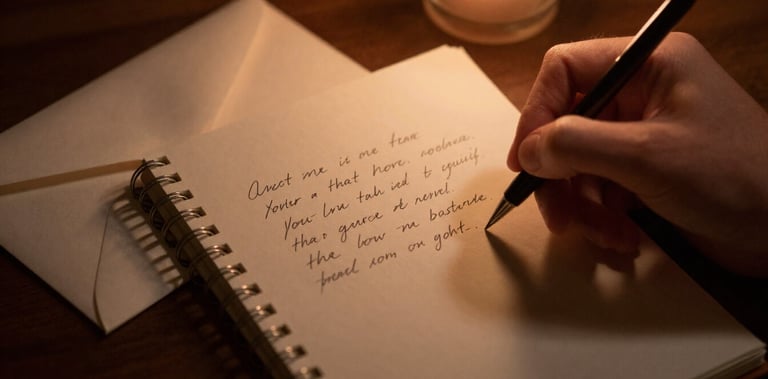
Choose someone, a parent, a past version of yourself, someone who hurt you, someone you miss, and write them a letter you will never send. The rule: write what you actually feel, not what you would say. No softening, no consideration for their feelings, no performance of magnanimity. What you discover is rarely what you expected to find. Often the letter reveals not grievance but grief, not anger but longing. The unsent letter bypasses social editing and goes directly to emotional truth. When you are done, read it back once. Then decide whether to keep it, burn it, or return to it in a month. The decision itself will tell you something.
2. The Dialogue With a Younger Self
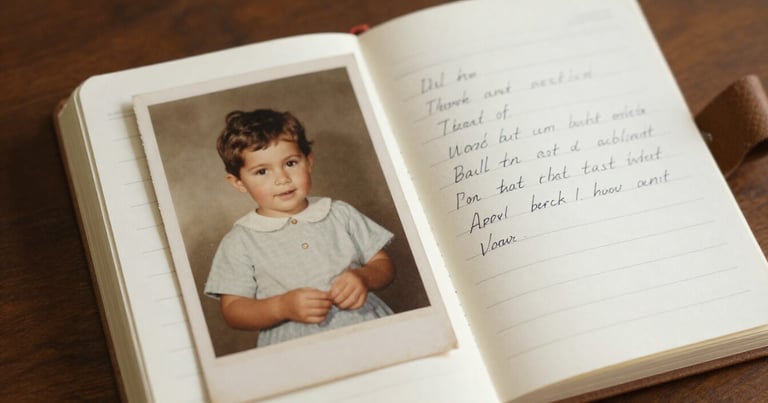
Choose an age, seven, twelve, fifteen, nineteen, and write a dialogue between your current self and who you were then. Ask your younger self what they needed that they didn't receive. Listen. Write their answer in first person, as them. This practice is also closely related to working with [your intuition vs. anxiety](/intuition-vs-anxiety/), because many of what we interpret as irrational fears are actually the younger self's survival patterns speaking. The dialogue does not aim to fix anything. It aims to restore contact. Often, the younger self turns out to be considerably wiser, and less damaged, than you assumed.
3. Dream Fragments as Doorways
You do not need to remember an entire dream to work with it. A single image is enough: a door that wouldn't open, a room you'd never seen before, a face you didn't recognize. Write the image at the top of the page. Then write: If this image had something to tell me, it would say... and let the pen move without reasoning. Dreams speak in metaphor and your waking mind is often the last to understand what they mean. Keeping a dedicated dream section, even just two or three lines each morning, changes your relationship to the interior life over time.
4. The Three-Question Morning Check-In
Before you reach for your phone in the morning, write for five minutes using three questions: What am I carrying from yesterday that I haven't processed? What am I avoiding thinking about? What does my body feel like right now, and what might that be telling me? You are not journaling to produce content. You are clearing the pipes before the day runs through them. The body question is important: many people carry emotional information somatically long before they can articulate it in language. Asking the body directly, through the mediation of the pen, often produces answers the mind would have dismissed. This practice is also a gentle on-ramp to [calming a racing mind](/breathwork-racing-mind/), because it externalizes the internal noise before it compounds.
5. Writing the Body
When you feel something strongly but cannot name it, describe it as a physical sensation instead. There is a tightening in my chest, about the size of a fist. It is the color of grey. It has a temperature: cool. If it had a voice it would sound like... This is not metaphor for its own sake. It is a technique for getting underneath the story into the raw experience. The thinking mind narrates; the sensing body holds the actual record. When you write from sensation rather than interpretation, you often arrive at an understanding that would not have come through analysis. Stay with the sensation in writing until it shifts, which it usually does.
The Paradox at the Heart of Self-Discovery
The more honestly you write, the more clearly you see that the self is not a fixed destination. It is a process. You do not journal until you have figured yourself out and then stop. You journal because the person you are keeps changing, and the practice keeps you in honest relationship with whoever you are becoming.
The pages where you write about being most confused are often the most useful ones to return to. Certainty forecloses. Confusion is honest. When you let the pen lead rather than follow your existing conclusions, you are doing something the conscious mind cannot do alone. You are letting the deeper intelligence have the floor.
The blank page is not a test. It is an invitation to find out.
Frequently Asked Questions
What if I don't know what to write when I open my journal?
Start with exactly that. Write: "I don't know what to write right now." Then write what is actually in your body or your mind in this moment, even if it seems boring or circular. Most people find that within three or four sentences of writing the truth of the moment, something beneath it surfaces. The discomfort of not knowing what to write is often protecting something you do know. Let the pen move anyway.
How often do I need to journal for it to make a difference?
Research by Dr. Pennebaker suggests that even four consecutive days of expressive writing produces measurable physiological effects. Consistency matters more than frequency: three focused sessions per week over several months will teach you more about yourself than thirty sporadic entries. The journal is most useful when it becomes a reliable place you return to, not a practice you squeeze into good weeks only.
Is there any journaling that could make things worse?
Yes. There is a meaningful difference between expressive writing and rumination. If you find yourself writing the same circular narrative repeatedly with no shift in perspective, you may be reinforcing the story rather than processing it. The antidote is to shift from narration to curiosity: instead of recounting what happened, ask what you feel, what you need, and what someone who loved you would say. If journaling consistently intensifies distress rather than moving through it, working with a therapist alongside the practice is wise.
How long before I notice changes from journaling regularly?
Most people notice a shift in their relationship to their own thoughts within two to four weeks. The more dramatic effect, a clearer sense of your values, patterns, and recurring emotional themes, tends to emerge over three to six months. Reading back through earlier entries is often one of the most useful parts of the practice. Distance gives perspective that is impossible to access from inside the experience.
Does journaling have anything to do with spirituality, or is it purely psychological?
The Stoics, the Japanese zuihitsu writers, and every contemplative tradition that used writing as a spiritual practice would say the psychological and the spiritual are not separate domains. Writing honestly about your inner life puts you in contact with something that cannot be accessed through performance or distraction: the truth of who you actually are beneath the story you tell about yourself. Whether you call that psychological health or spiritual awakening may depend on your language, not on the experience itself.
A blank page asks nothing of you except your honesty. It does not evaluate, compare, or withhold. It simply holds what you bring. Every person who has ever written something true on a piece of paper and then felt the strange relief of having said it knows what journaling, at its most essential, actually is.
The portal was never in the notebook. It was always in the willingness to begin.












© 2025. All rights reserved.
info@cosmiclifeflow.com