
Beyond Caffeine: The Natural Energy Solution
Why caffeine stops working + the cellular energy protocol combining mitochondrial support, Natural Energy Solution herbs & lifestyle rhythm. For women who've tried everything."
1/20/202615 min read


Beyond Caffeine: The Adaptogen-to-Cellular Energy Protocol for Women Who've Tried Everything
You know the ritual by heart. The alarm sounds, and before your eyes fully open, you're calculating: How many cups will it take to feel human today? Two? Three? By 2 PM, you're brewing your fourth, knowing it won't actually give you energy—just postpone the inevitable crash for another hour.
You've tried the green smoothies. The B-complex vitamins. The earlier bedtimes that somehow leave you just as exhausted. You've downloaded the meditation apps, invested in ashwagandha supplements, and sworn off sugar more times than you can count. Some things help—briefly. But nothing breaks the cycle of depending on caffeine to function, then lying awake at night because you had that last cup too late, then waking exhausted and reaching for coffee before your feet touch the floor.
If this exhausting loop feels inescapable, you're not imagining it. Twenty-nine percent of women now rank energy management as their number one health priority—ahead of weight, fitness, even mental health. We're collectively running on empty, and the conventional solutions aren't addressing what's actually broken.
Here's what you need to understand: Your fatigue isn't a character flaw requiring more discipline. It's not laziness that coffee temporarily masks. It's a biological reality playing out at the cellular level, in the tiny powerhouses inside every cell that are supposed to convert food into usable energy. When those cellular engines sputter and stall, no amount of caffeine can truly fix what's wrong. You're trying to jump-start a car with a failing battery—it might turn over for a moment, but it won't hold a charge.
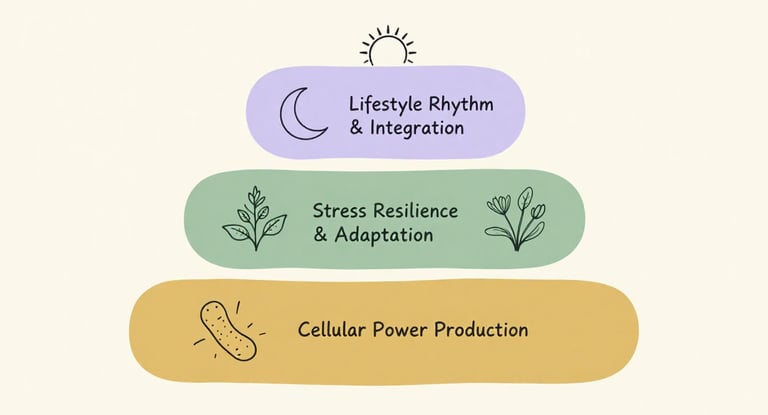
The solution isn't another quick fix. It's a layered protocol that addresses fatigue from the inside out: cellular energy production first, stress adaptation second, and lifestyle rhythm third. When you build energy from this foundation, adaptogens and lifestyle practices don't just work better—they work the way they were always meant to.
Why Caffeine Is a Band-Aid (And Why It Stops Working)
Let's be clear: caffeine isn't evil. That morning ritual of wrapping your hands around a warm mug, the familiar bitter-rich taste, the gentle lifting of mental fog—there's genuine value in this experience. Caffeine blocks adenosine receptors in your brain, temporarily preventing the "I'm tired" signal from getting through. For a few hours, you feel alert, focused, capable.
But here's what's actually happening beneath that temporary clarity: Caffeine doesn't create energy. It masks fatigue.
Your cells are still struggling to produce ATP—the molecular currency of energy that powers every thought, every heartbeat, every movement. Your mitochondria, the microscopic power plants inside each cell, are still operating below capacity. The adenosine is still accumulating, marking the genuine need for rest and cellular restoration. Caffeine simply blocks your awareness of all this, like unplugging your car's low-fuel warning light and pretending the tank isn't empty.
When the caffeine wears off, usually three to five hours later, all that accumulated adenosine floods your receptors at once. This is the crash—that sudden, heavy wave of exhaustion that feels worse than your baseline tiredness. Now you have a choice: more caffeine (perpetuating the cycle) or surrender to the crash (and lose the rest of your productive day).
The chronic caffeine cycle creates three specific problems for women:
Hormonal disruption. Caffeine elevates cortisol, your primary stress hormone. When cortisol stays elevated throughout the day, it interferes with the natural rhythm that should see it highest in the morning and lowest at night. This dysregulation affects your sleep quality, blood sugar balance, immune function, and reproductive hormones. Many women drinking three or more cups of coffee daily are unknowingly creating hormonal chaos that manifests as irregular cycles, mood swings, and—ironically—deeper fatigue.
Adrenal exhaustion. Your adrenal glands, which sit atop your kidneys like small hats, produce cortisol and adrenaline in response to stress signals. Caffeine triggers this stress response repeatedly throughout the day. Over months and years, the glands that are supposed to help you respond to genuine threats become depleted from constant false alarms. This adrenal fatigue makes you feel tired even when you're wired, anxious but exhausted, unable to summon energy for things you once loved.
Mitochondrial neglect. This is the piece most wellness advice misses entirely. When you rely on caffeine for energy instead of addressing why your cells aren't producing energy efficiently, you allow mitochondrial dysfunction to deepen. These cellular powerhouses need specific nutrients to function—CoQ10, magnesium, L-carnitine, NAD+ precursors (Nicolson, 2014). When they don't receive these raw materials, they slowly become less efficient at converting food into ATP. You need more and more caffeine to feel the same alertness, because the underlying energy production system is deteriorating.
The cruel paradox: The more you depend on caffeine to compensate for poor cellular energy production, the less incentive you have to address what's actually wrong. You're managing symptoms while the root cause quietly worsens.
This is why ashwagandha alone didn't fix your fatigue. Why meditation helps but doesn't eliminate your dependence on coffee. Why you still crash despite eating well and exercising. You've been building the second and third floors of energy restoration without laying the foundation—the cellular power system itself.
The Layered Energy Protocol: A Different Approach
Most fatigue solutions treat energy as one-dimensional: you're either tired or you're not. Take this supplement. Do this practice. Fix this one thing, and everything improves.
But energy in the human body exists in layers, each dependent on the others functioning well. Trying to fix fatigue at only one level is like renovating the upper floors of a house while the foundation crumbles. It might look better temporarily, but it won't hold.
The protocol that actually works addresses energy in the order your body creates it:
Layer One: Cellular Power Production (The Foundation) This is mitochondrial function—the biochemical machinery that converts food molecules into ATP, the energy currency your body actually uses. Every thought, heartbeat, and muscle contraction runs on ATP. When your mitochondria can't produce enough, everything else suffers. No adaptogen or lifestyle practice can compensate for failing cellular engines. This layer must be addressed first.
Layer Two: Stress Resilience & Adaptation (The Structure) This is where adaptogens shine—herbs like ashwagandha, rhodiola, and holy basil that help your body adapt to physical and emotional stress. They modulate cortisol, support hormonal balance, and help you maintain equilibrium during life's inevitable pressures. But adaptogens work by supporting cellular signaling and gene expression. If your cells lack the energy to respond to those signals, adaptogens can only do so much. They're incredibly powerful when built on a foundation of healthy mitochondria, far less effective when that foundation is compromised.
Layer Three: Lifestyle Rhythm & Integration (The Refinement) This includes sleep hygiene, movement practices, circadian rhythm alignment, and nutritional timing. These aren't optional—they're essential. But they're the final layer, the refinement that allows the foundation and structure to function optimally. You can have perfect sleep habits, but if your cells can't produce energy and your stress response is dysregulated, you'll still wake up tired.
The protocol isn't linear—it's cumulative. You don't wait until your mitochondria are perfect before adding adaptogens. You begin addressing all three layers simultaneously, but you understand their hierarchical relationship. You prioritize the foundation while building the structure and implementing the lifestyle practices.
This is why women who've "tried everything" often see dramatic shifts when they address energy in this layered way. They weren't doing the wrong things. They were doing the right things in the wrong order, or addressing one layer while neglecting the others.
Foundation Layer: Rebuilding Your Cellular Power Plants
Your mitochondria are not static structures. They're dynamic, responsive, and remarkably capable of regeneration when given what they need. But they require specific raw materials and supportive compounds to function optimally—nutrients that modern diets and lifestyles often fail to provide in adequate amounts.
The Mitochondrial Support Essentials:
Coenzyme Q10 (CoQ10) sits at the heart of your electron transport chain, the multi-step process where mitochondria actually create ATP. Without adequate CoQ10, this process becomes inefficient, like trying to run an assembly line with missing workers. A comprehensive meta-analysis of thirteen randomized controlled trials involving over 1,100 participants found that CoQ10 supplementation significantly reduced fatigue, with higher daily doses and longer treatment duration producing even greater improvements (Tsai et al., 2022). The remarkable finding: only one adverse event (mild digestive upset) was reported across 602 participants, suggesting exceptional safety.
Acetyl-L-Carnitine functions as a cellular fuel transporter, shuttling fatty acids across mitochondrial membranes so they can be burned for energy. Think of it as the delivery system that brings fuel to the engine. Clinical trials in older adults showed that acetyl-L-carnitine supplementation reduced physical fatigue scores by seven points compared to minimal change in placebo groups, while simultaneously improving mental fatigue, cognitive function, and body composition (Malaguarnera et al., 2008). These weren't subtle shifts—participants experienced a genuine restoration of vitality they'd assumed was lost to aging.
Pyrroloquinoline Quinone (PQQ) does something even more profound: it activates genes that trigger the creation of new mitochondria, a process called mitochondrial biogenesis. You're not just supporting existing cellular powerhouses—you're growing new ones. Research shows PQQ is up to 1,000 times more efficient than vitamin C in certain antioxidant functions (Jonscher et al., 2021), and human trials demonstrate measurable improvements in cognitive flexibility, muscle strength, and physical function within weeks of supplementation.
Magnesium is so fundamental to energy production that most cellular ATP exists as a magnesium-ATP complex. Without adequate magnesium, the ATP your cells produce can't actually be used. Yet magnesium deficiency is remarkably common, particularly in women. Clinical studies show magnesium supplementation significantly improves fatigue scores, energy levels, and quality of life—not by stimulating anything, but by enabling the cellular machinery to work as designed.(Yamanaka et al., 2016)
NAD+ Precursors (like niacinamide) raise levels of NAD+, a critical coenzyme involved in hundreds of metabolic reactions, including the conversion of food into cellular energy. NAD+ levels naturally decline with age, stress, and poor lifestyle factors. Research shows that supplementing with NAD+ precursors can increase cellular NAD+ levels by up to 60% within weeks, essentially restoring youthful energy metabolism.(Pirinen et al., 2020)
These compounds work synergistically, addressing different bottlenecks in cellular energy production. CoQ10 and NAD+ optimize the ATP creation process. L-carnitine ensures fuel reaches the mitochondria. PQQ creates new mitochondria while protecting existing ones. Magnesium makes the produced ATP usable. Together, they rebuild the foundation that everything else depends on.
When your cells can produce energy efficiently again, you notice the difference within days to weeks. The afternoon crash that sent you reaching for coffee simply doesn't hit as hard. You wake with a clarity that doesn't require immediate caffeine. Your thoughts feel sharper, your body lighter, your capacity for joy and presence wider.
This isn't stimulation. This is restoration—your body remembering what it feels like to run on genuine cellular energy rather than borrowed alertness from caffeine's blocking of fatigue signals.
Adaptation Layer: Building Stress Resilience That Actually Works
With cellular energy production supported, your body can finally respond to adaptogens the way traditional herbalism always intended. These aren't stimulants or sedatives—they're intelligence amplifiers, helping your system recognize and respond appropriately to stress.
Ashwagandha (Withania somnifera) has been revered in Ayurvedic medicine for over 3,000 years as a rasayana—a rejuvenative tonic. Modern research reveals why: ashwagandha modulates the HPA axis, the hormonal feedback loop governing your stress response. It doesn't suppress cortisol when you need it; it normalizes the rhythm. Studies show ashwagandha reduces fatigue by up to 40% while simultaneously improving sleep quality and reducing anxiety. When your mitochondria are functioning well, ashwagandha's cortisol-balancing effects allow your cells to stay in growth-and-repair mode rather than constant survival activation.
Rhodiola rosea increases oxygen utilization in cells and supports neurotransmitter balance, creating a state of calm alertness that feels entirely different from caffeine's jittery edge. Vikings used it to enhance endurance during long voyages. Modern studies confirm it significantly improves mental and physical performance during stress and fatigue, particularly in the context of burnout. With healthy mitochondrial function providing the baseline energy, rhodiola helps you access and maintain higher-performance states without depleting your reserves.
Holy Basil (Tulsi) offers a unique combination of calming and energizing properties, reducing cortisol and inflammation while improving mental clarity and physical stamina. It's especially valuable for women whose fatigue stems from chronic stress or anxiety. The herb supports healthy blood sugar balance, which prevents the energy crashes that often send people reaching for caffeine.
The protocol for adaptogens:
Start with one adaptogen for two to three weeks, noting how you respond. Ashwagandha works well taken in the evening because it supports sleep. Rhodiola is best in the morning for its energizing clarity. Holy basil can be consumed throughout the day as tea or capsules.
Quality matters tremendously. Look for standardized extracts with third-party testing. The most studied ashwagandha form is full-spectrum root and leaf extract standardized to withanolide content.
Adaptogens work cumulatively, not immediately. You're teaching your stress response system new patterns, which takes consistency over weeks. Unlike caffeine, which works instantly but stops working over time, adaptogens often take two to four weeks to show effects but continue improving with ongoing use.
Lifestyle Integration: The Practices That Sustain Everything
With foundation and structure in place, lifestyle practices become exponentially more effective. Sleep hygiene that felt impossible when you were exhausted becomes natural when your cells produce energy efficiently and your stress hormones are balanced.
Circadian alignment means working with your body's natural 24-hour rhythm rather than against it. Morning sunlight exposure within 30 minutes of waking sets your cortisol rhythm properly—high in morning for alertness, declining through the day for restful evening. Dimming lights after sunset, particularly blue light from screens, allows melatonin to rise naturally. When your mitochondrial and hormonal systems are supported, these practices feel restorative rather than like one more thing to do.
Movement as cellular activation doesn't require intense exercise. Gentle daily movement—walking, yoga, tai chi, dancing—signals to your mitochondria to maintain their energy-producing capacity. Research shows even light activity improves mitochondrial function, particularly when you're consistent. With cellular energy support and balanced stress hormones, movement becomes genuinely energizing rather than depleting.
Nutritional rhythm means eating in ways that support, rather than disrupt, your energy. Protein and healthy fats with every meal prevent blood sugar crashes. Intermittent fasting (if appropriate for you) can stimulate mitochondrial biogenesis. Colorful plant foods provide the polyphenols that protect mitochondria from oxidative damage. When your cellular engines run efficiently, food becomes fuel again rather than something that makes you sleepy.
The shift from protocol to lifestyle happens naturally when all three layers function together. You stop thinking "I should take my supplements" and start noticing "I feel better when I support my cells." You stop forcing yourself to meditate and start craving the stillness. You stop resisting sleep hygiene and start protecting it because you finally understand: this is how you feel alive.
Three Steps to Begin Your Energy Restoration Today
You don't need to implement everything at once. Sustainable change emerges from small, consistent actions that compound over time.
Step One: Assess Your Cellular Foundation
Before adding anything new, examine what might be depleting your mitochondrial function. Are you getting adequate magnesium from leafy greens, nuts, seeds? Does your diet include CoQ10-rich foods like sardines, organ meats, or spinach? (Likely not in therapeutic amounts, which is why supplementation helps.) Do you have chronic inflammation or oxidative stress from poor diet, environmental toxins, or unmanaged illness?
Consider comprehensive mitochondrial support that addresses multiple pathways simultaneously. Advanced formulas combining CoQ10, PQQ, acetyl-L-carnitine, magnesium, NAD+ precursors, and protective compounds like quercetin and alpha-lipoic acid work synergistically to rebuild cellular energy capacity far more effectively than isolated nutrients.(Zhang et al., 2010)
Step Two: Choose Your Primary Adaptogen
Based on your dominant pattern, select one adaptogen to begin:
If anxiety and racing thoughts accompany your fatigue: ashwagandha
If you experience burnout and mental fog: rhodiola
If stress manifests as emotional volatility and inflammation: holy basil
Take it consistently for one month before evaluating. Journal how you feel—energy levels, sleep quality, stress resilience, mental clarity. Adaptogens work best with patience.
Step Three: Implement One Circadian Rhythm Practice
Choose the practice that feels most accessible:
Morning sunlight: 10-15 minutes outside within an hour of waking
Evening wind-down: Dim lights two hours before bed, no screens one hour before sleep
Consistent sleep-wake times: Same bedtime and wake time, even weekends
Start with one. Make it non-negotiable for two weeks. Notice how it affects everything else.
A Comprehensive Solution: When You Want Everything in One Formula
Understanding individual ingredients empowers you. But sourcing, dosing, and combining them correctly can feel overwhelming when you're already exhausted. This is where comprehensive, research-backed formulations become genuinely valuable.
Advanced Mitochondrial Formula brings together the essential cellular energy nutrients in therapeutic doses designed to work synergistically: CoQ10 for electron transport chain function, PQQ for mitochondrial biogenesis, acetyl-L-carnitine for fuel delivery, alpha-lipoic acid for antioxidant protection, D-ribose for ATP synthesis, resveratrol for sirtuin activation, quercetin and curcumin for anti-inflammatory support, magnesium for energy activation, and niacinamide as an NAD+ precursor.
What distinguishes a quality formula from isolated supplements:
Synergy. These compounds amplify each other's effects. CoQ10 protects mitochondria; PQQ creates new ones. L-carnitine delivers fuel; D-ribose provides building blocks for ATP. Curcumin reduces inflammation that impairs mitochondrial function; black pepper extract increases curcumin absorption by up to 2,000%. Together, they address energy production from multiple angles simultaneously.
Therapeutic dosing. Effective amounts differ significantly from what foods provide. While you should eat CoQ10-rich foods, getting the 100-200mg shown effective in clinical trials requires supplementation. Quality formulas provide research-supported doses, not token amounts.
Quality and bioavailability. Manufacturing standards matter. Look for products made in FDA-registered, GMP-certified facilities with third-party testing. Bioavailable forms—ubiquinol instead of ubiquinone, acetyl-L-carnitine instead of L-carnitine—ensure your body can actually use what you're taking.
Is a comprehensive formula required for energy restoration? No. You can source each ingredient individually through diet and targeted supplements. But for many women juggling full lives while exhausted, a scientifically-formulated solution that addresses the complete foundation removes barriers to consistency—which matters more than perfection.
Learn more about Advanced Mitochondrial Formula
The question isn't whether supplementation is necessary or whether lifestyle alone suffices. The question is: What actually works for you, and what will you do consistently?
Frequently Asked Questions
How long does it take to feel results from mitochondrial support?
Most people notice subtle improvements within one to two weeks—slightly better morning clarity, reduced afternoon crashes, improved exercise recovery. Deeper restoration emerges over four to twelve weeks as mitochondrial function genuinely improves and new mitochondria are generated. This isn't suppression of symptoms; it's biological regeneration, which takes time. Consistency matters more than intensity. Taking therapeutic doses daily for three months produces far better results than sporadic high doses.
Can I take adaptogens and mitochondrial support together?
Yes, and they often work better in combination. Mitochondrial nutrients provide the cellular foundation that allows adaptogens to function optimally. Ashwagandha's stress-hormone balancing effects work through cellular signaling pathways—when those cells have adequate energy, the adaptogen's messages are received clearly. Think of mitochondrial support as the hardware and adaptogens as the software; both are necessary for the system to run well.
Will I always need supplements, or can I eventually stop?
Mitochondrial support can be phased from therapeutic to maintenance dosing as your energy improves. Many people use higher doses for three to six months to restore function, then reduce to maintenance amounts. Others find that ongoing support, particularly with CoQ10 and magnesium, helps sustain the improvements. Your needs may vary with life stress, age, and health status. The goal isn't lifetime dependence but giving your body what it needs during the restoration phase—then reassessing.
Is this approach safe if I have thyroid issues or take medications?
Generally yes, but consult your healthcare provider, especially if you take medications. Ashwagandha can influence thyroid function, which is beneficial for many but requires monitoring if you take thyroid medication. Magnesium can affect absorption of certain medications and should be taken several hours apart. CoQ10 may interact with blood thinners. Quality practitioners increasingly recognize mitochondrial health as fundamental to managing chronic conditions, but personalized guidance matters.
What if I still need some caffeine? Have I failed the protocol?
Absolutely not. The goal isn't caffeine elimination through willpower—it's restoring energy production so caffeine becomes a choice rather than a necessity. Many people find they naturally reduce caffeine consumption from four cups to one when their cells produce energy efficiently. That morning ritual remains pleasurable without the desperate dependence. If you enjoy coffee, continue enjoying it. The difference is you're no longer held hostage by it.
Your Path Beyond Exhaustion
You've been tired for so long that exhaustion feels like your baseline, like this is just who you are now. You've learned to function through it, to smile despite it, to accomplish what needs accomplishing even though moving through the day feels like walking through water.
But somewhere beneath that learned tolerance, you remember what energy actually feels like. Not the jittery, borrowed alertness of caffeine. Not the forced march of willpower pushing through depletion. Real energy—the kind that arises from cells functioning as they were designed to, that allows you to be present for your life instead of just surviving it.
That energy isn't lost. It's waiting for the conditions that allow it to return.
The layered protocol works because it addresses energy the way your body actually creates it—from the cellular foundation up. When your mitochondria receive the nutrients they need to function, when adaptogens help your stress response find equilibrium, when lifestyle practices support rather than disrupt natural rhythms, energy doesn't have to be forced. It emerges naturally, the way it did before chronic stress and nutrient depletion and modern life dimmed your inner fire.
You deserve to wake up feeling rested. To move through your afternoon without needing stimulants. To have enough energy left at day's end to enjoy your life instead of just collapsing. To feel fully alive in your body instead of constantly negotiating with exhaustion.
This isn't about adding more to your overwhelmed plate. It's about addressing what's actually wrong—systematically, scientifically, compassionately—so that everything else becomes easier.
Your cellular engines can be rebuilt. Your stress resilience can be restored. Your natural rhythms can be honored. The vitality you've been chasing through caffeine and willpower already lives inside you, waiting for the foundation that allows it to flourish.
Begin with one layer. Then another. Build the protocol that supports your unique body, your real life. The energy you're seeking isn't somewhere else. It's beneath the depletion, waiting for you to remember how to tend the fire that's always been burning inside you.
The protocol is waiting. Your vitality is waiting. All you need to do is begin.








Connect
© 2025. All rights reserved.
info@cosmiclifeflow.com